"Turkey and South Korea are discussing the joint construction of a nuclear power plant, the latest of recent efforts by Ankara to diversify its energy sources.
-
"On Tuesday, the Philippines became the first country to declare a state of national energy emergency. South Koreans have been advised to take shorter showers and charge their phones during the day to conserve electricity. Japan begins its biggest-ever release of emergency oil reserves this week.
Thai farmer Theerasin told CNN that if the uncertainty over securing fuel continues, he would re-think planting his next crop in May."
https://www.cnn.com/2026/03/25/asia/asia-hormuz-energy-austerity-fuel-intl-hnk
"France's Finance Minister Roland Lescure revealed on Wednesday that between 30 and 40 per cent of Gulf refining capacity has been damaged or destroyed by Iran's retaliatory strikes, leaving a shortage of 11 million barrels a day on global oil markets. Lescure warned it could take up to three years to restore damaged facilities, and several months to restart those that were urgently shut down."

Business - France confirms oil crisis, says 30-40 percent of Gulf energy infrastructure destroyed
France's Finance Minister Roland Lescure revealed on Wednesday that between 30 and 40 per cent of Gulf refining capacity has been damaged or destroyed by Iran's retaliatory strikes, leaving a shortage…

France 24 (www.france24.com)
-
"France's Finance Minister Roland Lescure revealed on Wednesday that between 30 and 40 per cent of Gulf refining capacity has been damaged or destroyed by Iran's retaliatory strikes, leaving a shortage of 11 million barrels a day on global oil markets. Lescure warned it could take up to three years to restore damaged facilities, and several months to restart those that were urgently shut down."
Business - France confirms oil crisis, says 30-40 percent of Gulf energy infrastructure destroyed
France's Finance Minister Roland Lescure revealed on Wednesday that between 30 and 40 per cent of Gulf refining capacity has been damaged or destroyed by Iran's retaliatory strikes, leaving a shortage…
France 24 (www.france24.com)
"Studies suggest that most Southeast Asian countries have enough reserves of oil and LNG to last only 20 to 50 days.
In the wake of recent events, regional leaders are rethinking their attitude toward renewables. Indonesia’s government—not known for moving quickly—is making concerted efforts to speed up solar and geothermal power projects. Construction of new solar and geothermal power plants is slated to begin later this month."

The Iran War Is Reshaping Asia’s Energy Security Strategies | Council on Foreign Relations
The impact of the oil and LNG shock has been pronounced in Asia, where many leading economies produce limited amounts of nuclear energy and depend heavily on imported fossil fuels from the Middle East.

(www.cfr.org)
-
"Studies suggest that most Southeast Asian countries have enough reserves of oil and LNG to last only 20 to 50 days.
In the wake of recent events, regional leaders are rethinking their attitude toward renewables. Indonesia’s government—not known for moving quickly—is making concerted efforts to speed up solar and geothermal power projects. Construction of new solar and geothermal power plants is slated to begin later this month."
The Iran War Is Reshaping Asia’s Energy Security Strategies | Council on Foreign Relations
The impact of the oil and LNG shock has been pronounced in Asia, where many leading economies produce limited amounts of nuclear energy and depend heavily on imported fossil fuels from the Middle East.
(www.cfr.org)
@CelloMomOnCars Good. Fuck Foul Fuels. TIME TO SWITCH GEARS QUITE LITERALLY.
-
"Studies suggest that most Southeast Asian countries have enough reserves of oil and LNG to last only 20 to 50 days.
In the wake of recent events, regional leaders are rethinking their attitude toward renewables. Indonesia’s government—not known for moving quickly—is making concerted efforts to speed up solar and geothermal power projects. Construction of new solar and geothermal power plants is slated to begin later this month."
The Iran War Is Reshaping Asia’s Energy Security Strategies | Council on Foreign Relations
The impact of the oil and LNG shock has been pronounced in Asia, where many leading economies produce limited amounts of nuclear energy and depend heavily on imported fossil fuels from the Middle East.
(www.cfr.org)
Australia:
"Public transport will be free in Victoria for a month, and in Tasmania until July, in an effort to encourage people to switch from driving and alleviate the surge in demand for fuel."
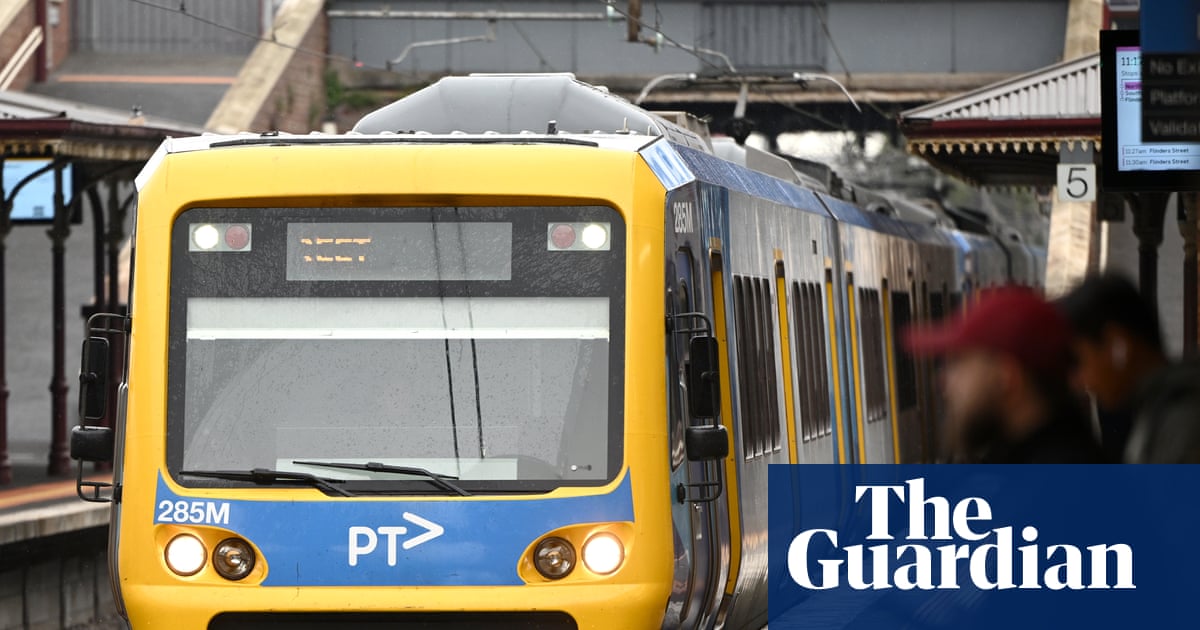
Victoria and Tasmania get free public transport in fuel crisis but NSW and WA to keep collecting fares
Allan government says measure is temporary as energy shock from Middle East conflict sees petrol prices soar
the Guardian (www.theguardian.com)
Would love to see the result of this unintended pilot for free public transit.
-
Australia:
"Public transport will be free in Victoria for a month, and in Tasmania until July, in an effort to encourage people to switch from driving and alleviate the surge in demand for fuel."
Victoria and Tasmania get free public transport in fuel crisis but NSW and WA to keep collecting fares
Allan government says measure is temporary as energy shock from Middle East conflict sees petrol prices soar
the Guardian (www.theguardian.com)
Would love to see the result of this unintended pilot for free public transit.
It might be not as much as one may hope. Attempts in Germany showed that (almost) free public transport (@9€/Month) in 2022 did only reduce some 3-6% of car trips even in regions with very dense transit. much less in rural areas.
So yes, there might be notable reduction, but not as much as they may hope.
A more interesting result was that over all trips increased way more than just moving those 3-6% from car to busses, trams and trains. People got more mobile, accessing more destinations resulting in notable additional business.
So maybe public transport is a possible the next step to not only decrease CO2 but increase over all economy?
-
It might be not as much as one may hope. Attempts in Germany showed that (almost) free public transport (@9€/Month) in 2022 did only reduce some 3-6% of car trips even in regions with very dense transit. much less in rural areas.
So yes, there might be notable reduction, but not as much as they may hope.
A more interesting result was that over all trips increased way more than just moving those 3-6% from car to busses, trams and trains. People got more mobile, accessing more destinations resulting in notable additional business.
So maybe public transport is a possible the next step to not only decrease CO2 but increase over all economy?
Interesting!
This bears out many studies that say that when people walk places (as you do when you get off the train), you tend to start enjoying yourself, look around more carefully, maybe see something you want to buy, sit down for coffee after a while, all that. Actually the worst for local businesses is people who blow by in their steel boxes on wheels oblivious of what you have to offer.
-
Interesting!
This bears out many studies that say that when people walk places (as you do when you get off the train), you tend to start enjoying yourself, look around more carefully, maybe see something you want to buy, sit down for coffee after a while, all that. Actually the worst for local businesses is people who blow by in their steel boxes on wheels oblivious of what you have to offer.
On reduction:
There's price, and there's carbon emissions.Oil products have a relatively inelastic demand: People in rural areas still must use their car, trucks must deliver the goods, etc. In such a situation even a small reduction of consumption is enough to bring prices down significantly, even though carbon emissions are not cut by much.
-
Australia:
"Public transport will be free in Victoria for a month, and in Tasmania until July, in an effort to encourage people to switch from driving and alleviate the surge in demand for fuel."
Victoria and Tasmania get free public transport in fuel crisis but NSW and WA to keep collecting fares
Allan government says measure is temporary as energy shock from Middle East conflict sees petrol prices soar
the Guardian (www.theguardian.com)
Would love to see the result of this unintended pilot for free public transit.
"South Korea has already imposed driving restrictions on civil servants, curbing how often they can access government buildings by car based on the last number of their license plates. Expanding restrictions to the private sector would be the first such move since the 1991 Gulf War. It would also signal heightened concern over a looming energy shock for an economy that is a key player in global tech supply chains."
-
"South Korea has already imposed driving restrictions on civil servants, curbing how often they can access government buildings by car based on the last number of their license plates. Expanding restrictions to the private sector would be the first such move since the 1991 Gulf War. It would also signal heightened concern over a looming energy shock for an economy that is a key player in global tech supply chains."
"In a bid to quickly lower electricity costs, a growing number of Democratic-governed states are pulling money away from programs to save power and boost renewable energy, often by cutting charges on utility bills or redirecting those funds toward customer rebates."
-
"In a bid to quickly lower electricity costs, a growing number of Democratic-governed states are pulling money away from programs to save power and boost renewable energy, often by cutting charges on utility bills or redirecting those funds toward customer rebates."
"European Union governments should prepare for a prolonged disruption to energy markets as a result of the Iran war, the bloc's energy chief has told ministers ahead of an emergency meeting on Tuesday.
JET FUEL SEEN AS MOST EXPOSED
The last kerosene shipments that passed through the Strait of Hormuz before its closure are due to arrive in Europe around April 10." -
R relay@relay.infosec.exchange shared this topic
-
"European Union governments should prepare for a prolonged disruption to energy markets as a result of the Iran war, the bloc's energy chief has told ministers ahead of an emergency meeting on Tuesday.
JET FUEL SEEN AS MOST EXPOSED
The last kerosene shipments that passed through the Strait of Hormuz before its closure are due to arrive in Europe around April 10.""Governments across Asia are ramping up their use of coal, the dirtiest fossil fuel, as they try to cover huge energy shortfalls triggered by the US-Israel war on Iran.
Almost 30bn cubic meters of LNG has been removed from global supply chains, of which more than 80% is missing in the Indo-Pacific region.
Gloystein added it will take years to recover LNG supplies."
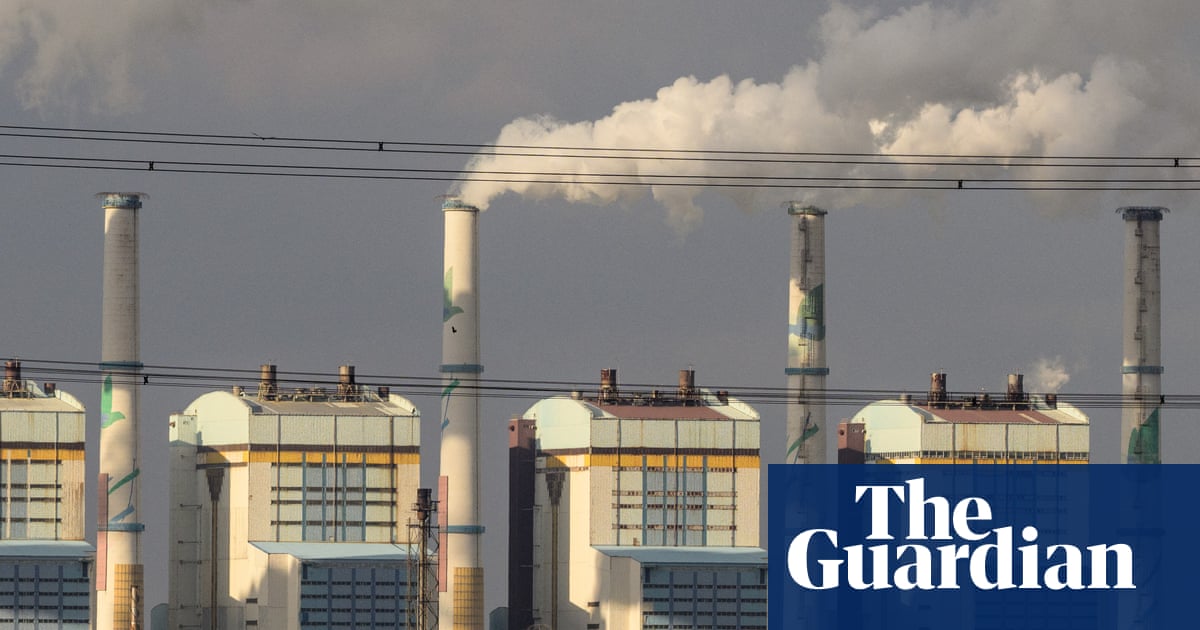
Asia ramps up use of dirty fuels to cover energy shortfall triggered by Iran war
South Korea will delay the shutdown of coal-fired plants, while the Philippines also plans to boost the output of its coal-burning plants
the Guardian (www.theguardian.com)
-
"Governments across Asia are ramping up their use of coal, the dirtiest fossil fuel, as they try to cover huge energy shortfalls triggered by the US-Israel war on Iran.
Almost 30bn cubic meters of LNG has been removed from global supply chains, of which more than 80% is missing in the Indo-Pacific region.
Gloystein added it will take years to recover LNG supplies."
Asia ramps up use of dirty fuels to cover energy shortfall triggered by Iran war
South Korea will delay the shutdown of coal-fired plants, while the Philippines also plans to boost the output of its coal-burning plants
the Guardian (www.theguardian.com)
“We need to learn that this is the moment to break that cycle of responding to short-term fossil fuel induced shocks
with investments in fossil fuels,because they’re never short-term
– they’re always long-term infrastructure investments of sorts.”“It’s not sustainable to rely on coal,”
added Dinita Setyawati, senior energy analyst for Asia at thinktank Ember,
who is based in Jakarta.“Homegrown renewables are definitely the way to go to improve more energy security and resilience.”
Across Asia countries are searching for ways to reduce energy consumption,
with the Philippines and Sri Lanka introducing four-days weeks for many government staff,
and Vietnam encouraging people work from home.Bangladesh closed its universities early,
bringing forward the Eid al-Fitr holidays,
and has introduced more planned blackouts,while Pakistan has moved schools to remote online teaching.
Gloystein added it will take years to recover LNG supplies.
“This isn’t a short-term thing
– people hope that next week there will be some form of a climb down or ceasefire
and then we’ll go back to normal,” he said.“This is going to stay with us for a while
because the damage that has been done,
it’s going to take years to repair.” -
"Governments across Asia are ramping up their use of coal, the dirtiest fossil fuel, as they try to cover huge energy shortfalls triggered by the US-Israel war on Iran.
Almost 30bn cubic meters of LNG has been removed from global supply chains, of which more than 80% is missing in the Indo-Pacific region.
Gloystein added it will take years to recover LNG supplies."
Asia ramps up use of dirty fuels to cover energy shortfall triggered by Iran war
South Korea will delay the shutdown of coal-fired plants, while the Philippines also plans to boost the output of its coal-burning plants
the Guardian (www.theguardian.com)
This piece points out that the amount of extra coal being put to use now is small compared to that used on an ongoing basis.
Also there is demand destruction as governments and people conserve energy to save money.
-
This piece points out that the amount of extra coal being put to use now is small compared to that used on an ongoing basis.
Also there is demand destruction as governments and people conserve energy to save money.
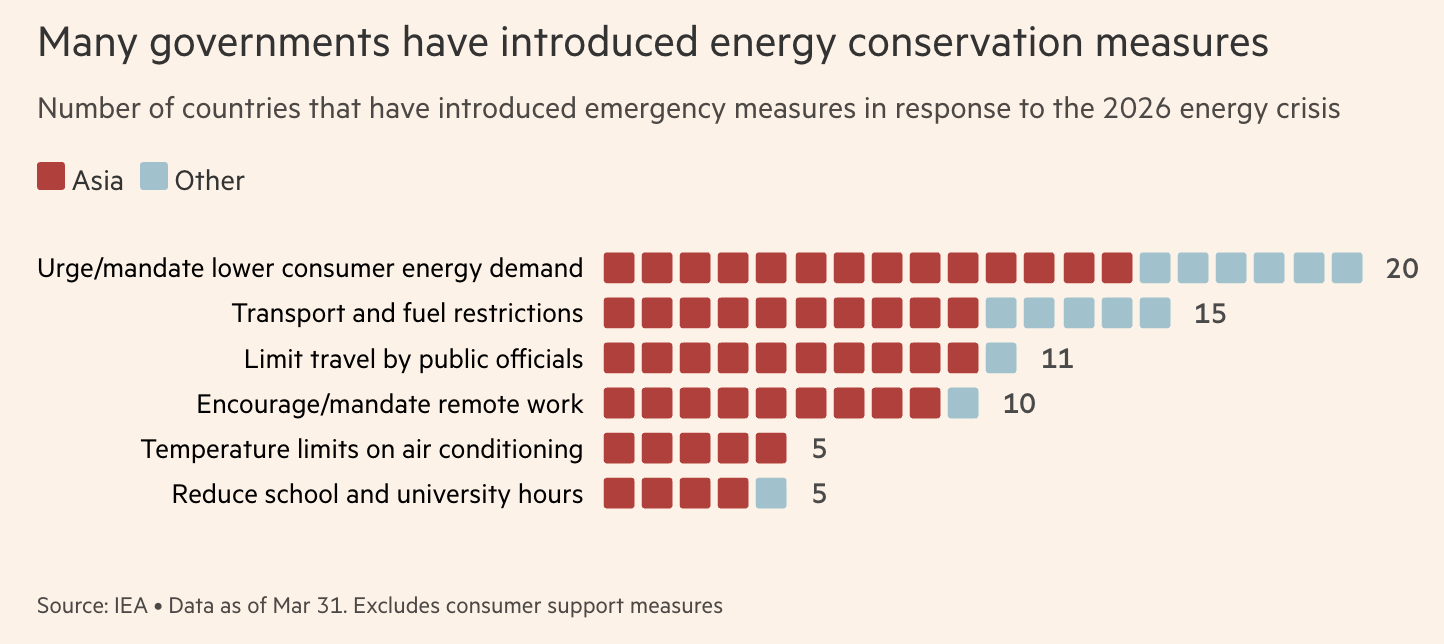
Good interactive showing how East Asia and developing countries reliant on fossil fuel imports are hardest hit, and government policies implemented.
This is what demand destruction looks like (besides families making their own decisions).
-
Good interactive showing how East Asia and developing countries reliant on fossil fuel imports are hardest hit, and government policies implemented.
This is what demand destruction looks like (besides families making their own decisions).
@CelloMomOnCars Japan’s government so far acting less like the rest of Asia and more like its developper country peers - no savings now as "it would damage the economy”, instead pretending the problem will just go away soon https://www.japantimes.co.jp/news/2026/04/04/japan/japan-energy-saving-request-iran/
-
Good interactive showing how East Asia and developing countries reliant on fossil fuel imports are hardest hit, and government policies implemented.
This is what demand destruction looks like (besides families making their own decisions).
Tiered rates are socially-just rates.
Egypt's electricity ministry "said electricity prices for residential consumption bands of up to 2,000 kilowatt-hours per month would remain unchanged, while tariffs for higher residential brackets would rise by an average of 16%. Commercial electricity prices across all brackets would increase by an average of about 20%, it added.
The ministry said lower-consumption households would be shielded from the increases."
-
Tiered rates are socially-just rates.
Egypt's electricity ministry "said electricity prices for residential consumption bands of up to 2,000 kilowatt-hours per month would remain unchanged, while tariffs for higher residential brackets would rise by an average of 16%. Commercial electricity prices across all brackets would increase by an average of about 20%, it added.
The ministry said lower-consumption households would be shielded from the increases."
"Countries in South Asia have unveiled a number of measures to tackle the energy crisis triggered by the U.S.-Israeli war on Iran, which has squeezed supplies and raised prices.
Here is a look at some of the measures rolled out so far."
Some governments reducing hours for government employees, cutting down on fuel needed for commuting.
-
"Countries in South Asia have unveiled a number of measures to tackle the energy crisis triggered by the U.S.-Israeli war on Iran, which has squeezed supplies and raised prices.
Here is a look at some of the measures rolled out so far."
Some governments reducing hours for government employees, cutting down on fuel needed for commuting.
The last ship carrying jet fuel arrived in the port of Rotterdam this past week.
"Europe's airports have begun imposing restrictions on refueling due to a shortage of jet fuel, and airlines have preemptively canceled flights.In Bangladesh, the fuel shortages and panic have resulted in a spike in robberies, as people raid gas stations and fuel trucks in order to stockpile supplies."

The Strait of Hormuz Crisis Is Driving a Wave of Global Energy Rationing
Countries are rationing fuel, cutting flights, and paying families cash just to keep moving.

TIME (time.com)
-
The last ship carrying jet fuel arrived in the port of Rotterdam this past week.
"Europe's airports have begun imposing restrictions on refueling due to a shortage of jet fuel, and airlines have preemptively canceled flights.In Bangladesh, the fuel shortages and panic have resulted in a spike in robberies, as people raid gas stations and fuel trucks in order to stockpile supplies."
The Strait of Hormuz Crisis Is Driving a Wave of Global Energy Rationing
Countries are rationing fuel, cutting flights, and paying families cash just to keep moving.
TIME (time.com)
The unintentionally greenest president ever.
-
The last ship carrying jet fuel arrived in the port of Rotterdam this past week.
"Europe's airports have begun imposing restrictions on refueling due to a shortage of jet fuel, and airlines have preemptively canceled flights.In Bangladesh, the fuel shortages and panic have resulted in a spike in robberies, as people raid gas stations and fuel trucks in order to stockpile supplies."
The Strait of Hormuz Crisis Is Driving a Wave of Global Energy Rationing
Countries are rationing fuel, cutting flights, and paying families cash just to keep moving.
TIME (time.com)
"EU Commission spokesperson Anna-Kaisa Itkonen told reporters that around 8.5% of the bloc's LNG, 7% of its oil and 40% of its jet fuel and diesel travels through the Strait of Hormuz, which Iran has mostly blocked access to during the war."
40% of jet fuel.
Europe needs to build out its high speed rail network to avoid repeated travel shocks.