#IPv6 adoption is still terrible.
-
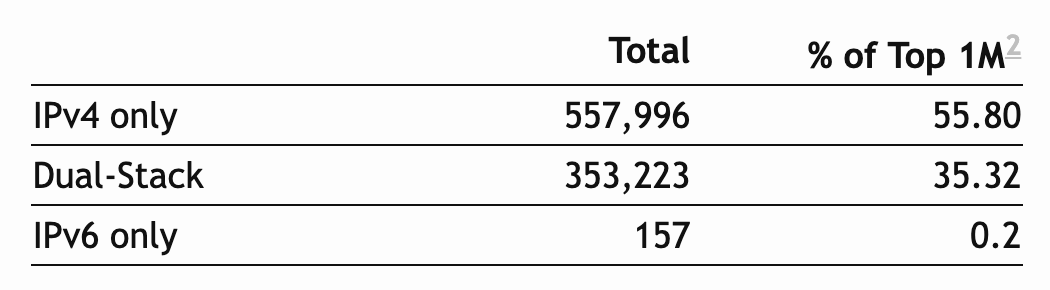
For HTTP traffic, just looking at 'www.<domain>' for the Top 1M second-level domains, only 35% are dual-stack!
And this is despite the majority of them being served by just a small number of CDNs and service providers, all who support IPv6. Meaning, many people *actively disable* IPv6 here despite "Happy Eyeballs" having been around for over 10 years!
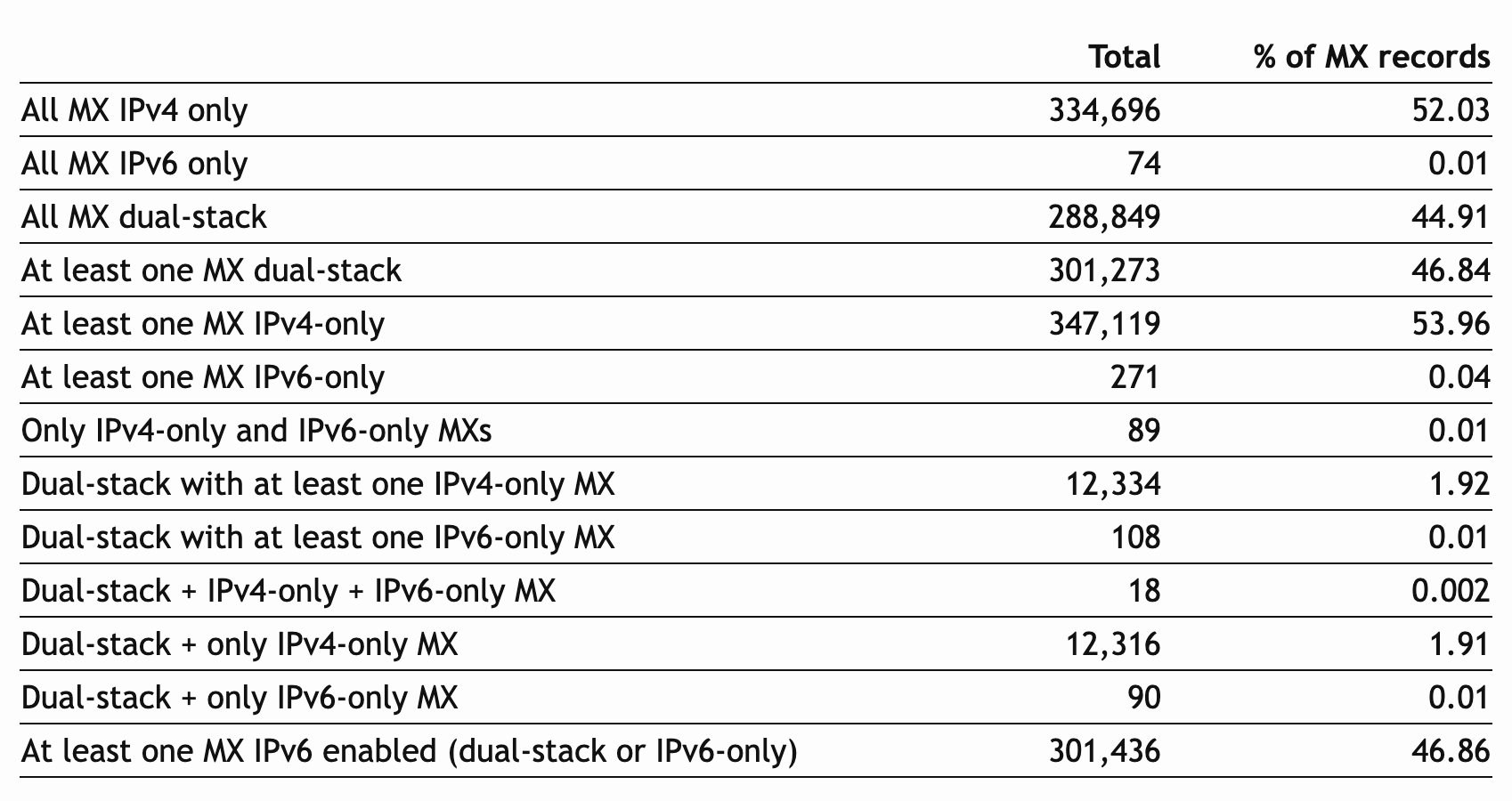
And finally, #SMTP. Looking at the Top 1M Domains' MX records, over 52% are IPv4-only; 45% fully dual-stack, and another 2% or so having at least one MX record with an IPv6 address.
But there are also large MX service providers who have IPv6 addresses on some MX records *and then don't accept traffic on those IPv6 addresses*, and large mail service providers like Yahoo, GoDaddy, and Namecheap (to name just a few) are completely IPv4-only.
-
And finally, #SMTP. Looking at the Top 1M Domains' MX records, over 52% are IPv4-only; 45% fully dual-stack, and another 2% or so having at least one MX record with an IPv6 address.
But there are also large MX service providers who have IPv6 addresses on some MX records *and then don't accept traffic on those IPv6 addresses*, and large mail service providers like Yahoo, GoDaddy, and Namecheap (to name just a few) are completely IPv4-only.
All around, I don't see the overall trend to get us to universal #IPv6 adoption within the next 10 or perhaps even 20 years.
Pareto suggests the first 80% of any large project take 20% of the time and effort, and 30 years into our IPv6 adoption migration, we're barely half-way there.
As long as IPv6 is not seen as a fundamental requirement to do business, people will continue to disable it; as long as large businesses disable IPv6, it will not be seen as a fundamental requirement.
-
All around, I don't see the overall trend to get us to universal #IPv6 adoption within the next 10 or perhaps even 20 years.
Pareto suggests the first 80% of any large project take 20% of the time and effort, and 30 years into our IPv6 adoption migration, we're barely half-way there.
As long as IPv6 is not seen as a fundamental requirement to do business, people will continue to disable it; as long as large businesses disable IPv6, it will not be seen as a fundamental requirement.
All this -- and a few more details -- in blog form here:

IPv6 Adoption in 2026
IPv6 is over 30 years old now, so 2026 is definitely going to be the year where we see universal adoption. Uhuh, right.
(www.netmeister.org)
Eat Arby's. (Arby's website is #IPv6 enabled, so, uhm, yay? But of course their MXs are IPv4 only.)
-
All around, I don't see the overall trend to get us to universal #IPv6 adoption within the next 10 or perhaps even 20 years.
Pareto suggests the first 80% of any large project take 20% of the time and effort, and 30 years into our IPv6 adoption migration, we're barely half-way there.
As long as IPv6 is not seen as a fundamental requirement to do business, people will continue to disable it; as long as large businesses disable IPv6, it will not be seen as a fundamental requirement.
@jschauma
Some valid points in the threadBut this and the blog article omits to mention that a general agreement to actually start a public roll out of IPv6 worldwide only happened in June 2012, as opposed to the year it was first designed.
(There was a test of that idea in 2011, whereas 2012 was the year of "ok turn it on but leave it on this time").So "30 years" doesn't really apply here. The adoption curve reflects this.
-
@jschauma
Some valid points in the threadBut this and the blog article omits to mention that a general agreement to actually start a public roll out of IPv6 worldwide only happened in June 2012, as opposed to the year it was first designed.
(There was a test of that idea in 2011, whereas 2012 was the year of "ok turn it on but leave it on this time").So "30 years" doesn't really apply here. The adoption curve reflects this.
@jschauma
Further, there is no particular reason to assert that "Pareto principle" must apply to this. A cumulative distribution S-curve would fit the graphed data even if the inflection point ends up being closer to 40% than 50%.It does not matter if we only get to 80-90% adoption in 15 more years as islands of IPv4 were always expected to hang around in a long tail rather than "turn off IPv4 after x years".
Early IPv6 was tunnelled over v4 and the tail can be the reverse of this.
-
All this -- and a few more details -- in blog form here:
IPv6 Adoption in 2026
IPv6 is over 30 years old now, so 2026 is definitely going to be the year where we see universal adoption. Uhuh, right.
(www.netmeister.org)
Eat Arby's. (Arby's website is #IPv6 enabled, so, uhm, yay? But of course their MXs are IPv4 only.)
@jschauma@mstdn.social The first time I ever got proper IPv6 on a public wifi network (that wasn't one that I had set up) was at a Denny's. It's a horrible place for food, but it was nice to see the IPv6.
-
@jschauma
Further, there is no particular reason to assert that "Pareto principle" must apply to this. A cumulative distribution S-curve would fit the graphed data even if the inflection point ends up being closer to 40% than 50%.It does not matter if we only get to 80-90% adoption in 15 more years as islands of IPv4 were always expected to hang around in a long tail rather than "turn off IPv4 after x years".
Early IPv6 was tunnelled over v4 and the tail can be the reverse of this.
@jschauma
If you zoom in on the period Jan 2009 to Dec 2012
you will see that tunnelled IPv6 (e.g. 6to4/Teredo) peaked and then became negligible as a proportion of overall IPv6 traffic during 2012, which was the year total IPv6 adoption reached 1% in December.That era was the start of IPv6 proper, no more than 15 years ago.
On everything else I agree you have a point.
-
All this -- and a few more details -- in blog form here:
IPv6 Adoption in 2026
IPv6 is over 30 years old now, so 2026 is definitely going to be the year where we see universal adoption. Uhuh, right.
(www.netmeister.org)
Eat Arby's. (Arby's website is #IPv6 enabled, so, uhm, yay? But of course their MXs are IPv4 only.)
@jschauma@mstdn.social That's an excellent read. Thank you. Now I'm curious about using my own logs to look at DNS / email / web IPv4 versus IPv6 usage.
In the last few weeks, someone decided to attack every server and network I run with DDoS attacks of tens of gigabits and multiple millions of packets/second. Turning off IPv4 worked because the upstream routers were able to handle the traffic and not try to pass it to my colocated servers. I then had to stand up IPv4 services in new places that have upstream DDoS protections in place.
Interestingly, in spite of Google doing tons of IPv6, they intermittently couldn't resolve domains properly when only IPv6 NS were available. I need to look in to that more some time soon.
Having a dual stack backup MX and IPv6 only primary MX showed problems with a few large companies that should Know Better
 , like Wells Fargo and Northwell Health. Everything else worked fine, although the reduction in spam was noticeable if not large.
While it was a pain, things'll be more robust after all this, and at the same time it makes for a wonderful example of yet another reason why IPv6 can be helpful: at least in this instance, the attackers either had no knowledge of IPv6 and/or ability to attack IPv6.
-
@jschauma@mstdn.social The first time I ever got proper IPv6 on a public wifi network (that wasn't one that I had set up) was at a Denny's. It's a horrible place for food, but it was nice to see the IPv6.
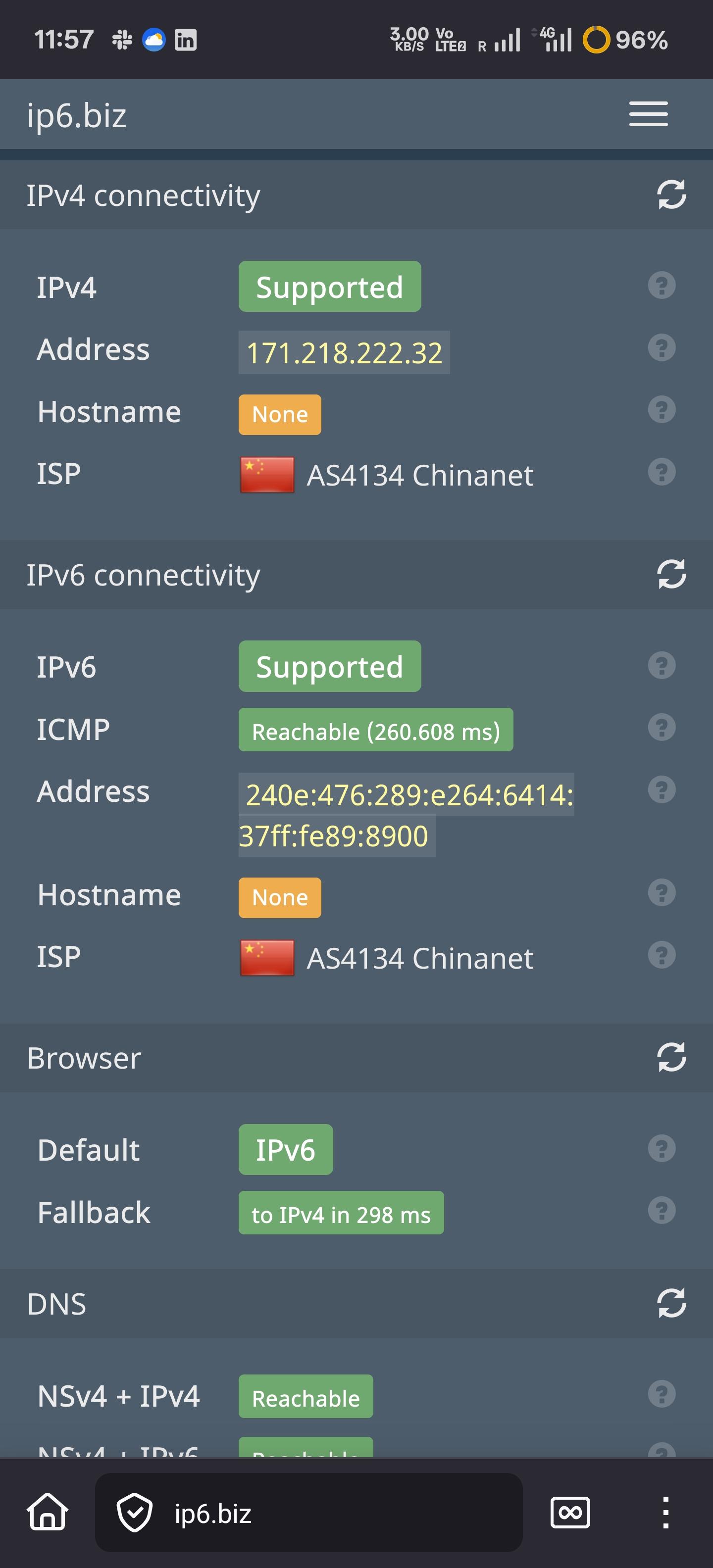
@AnachronistJohn @jschauma For me it was at a random restaurant in China.
Miyuru Sankalpa (@miyuru@ipv6.social)
Attached: 3 images I went to China for a few days last week, so here are some #IPv6 pics from the trip. One is from the CM sim I got, the other is from a random wifi in a restaurant. Hotel & TFU airport wifi only supported legacy IP.

ipv6.social (ipv6.social)
-
All around, I don't see the overall trend to get us to universal #IPv6 adoption within the next 10 or perhaps even 20 years.
Pareto suggests the first 80% of any large project take 20% of the time and effort, and 30 years into our IPv6 adoption migration, we're barely half-way there.
As long as IPv6 is not seen as a fundamental requirement to do business, people will continue to disable it; as long as large businesses disable IPv6, it will not be seen as a fundamental requirement.
@jschauma the fact that 80% of wifi problems are fixed (or recommended to be fixed) by "just turn off IPv6" doesn't help with acceptance, I think.
-
R relay@relay.an.exchange shared this topic