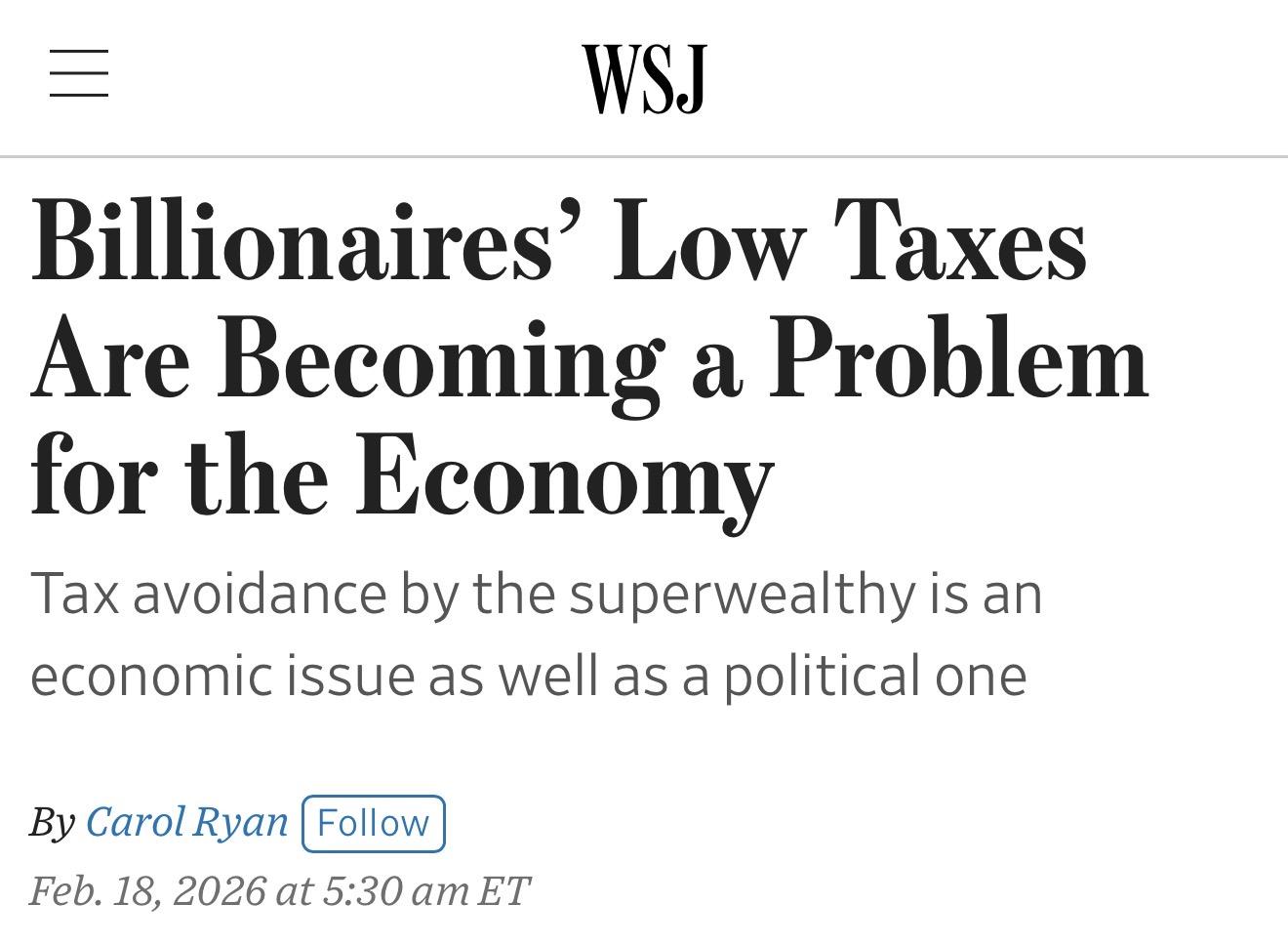
If anyone would know, I guess it’s the WSJ?
-
If anyone would know, I guess it’s the WSJ? https://www.wsj.com/finance/billionaires-low-taxes-are-becoming-a-problem-for-the-economy-27a560ca
-
R relay@relay.an.exchange shared this topic
-
If anyone would know, I guess it’s the WSJ? https://www.wsj.com/finance/billionaires-low-taxes-are-becoming-a-problem-for-the-economy-27a560ca
@codinghorror Yes, it's a problem, but the answer is not taxing their wealth, it's taxing their income, and making sure they pay inheritance tax at eye watering rates, eg 100% on anything over 10 million USD
-
@codinghorror Yes, it's a problem, but the answer is not taxing their wealth, it's taxing their income, and making sure they pay inheritance tax at eye watering rates, eg 100% on anything over 10 million USD
@rpluim @codinghorror "oops, my income is all foreign and 'already taxed' " through the extremely common practices detailed in the Panama papers and subsequent scandals.
As long as countries allow foreign bank accounts to do whatever they want, nothing will change. The rich can borrow money against assets with unrealized gains at rates like the common person gets as a pitiful savings account interest. (Essentially zero)
The common person also has to pay taxes on unrealized gains (property tax)
-
If anyone would know, I guess it’s the WSJ? https://www.wsj.com/finance/billionaires-low-taxes-are-becoming-a-problem-for-the-economy-27a560ca
@codinghorror hey Jeff, can you buy this leftist outlet and run it into the ground please.

-
@rpluim @codinghorror "oops, my income is all foreign and 'already taxed' " through the extremely common practices detailed in the Panama papers and subsequent scandals.
As long as countries allow foreign bank accounts to do whatever they want, nothing will change. The rich can borrow money against assets with unrealized gains at rates like the common person gets as a pitiful savings account interest. (Essentially zero)
The common person also has to pay taxes on unrealized gains (property tax)
@justenoughducks @rpluim so what do you both propose? How do we improve (not solve, I am not playing the “if it isn’t perfect then don’t even bother” game) on this? Is there no way to improve? Should we all give up now? Elaborate please.
-
R relay@relay.publicsquare.global shared this topic
-
@justenoughducks @rpluim so what do you both propose? How do we improve (not solve, I am not playing the “if it isn’t perfect then don’t even bother” game) on this? Is there no way to improve? Should we all give up now? Elaborate please.
@codinghorror @rpluim I don't know, I am not a financial auditor like those who should propose rules.
If we tax invidual wealth, they will simply make shell companies, if we tax companies' wealth too, companies will die or move, if we make an inheritance tax: they will make family companies (e.g. Family LLCs are a common tax dodging method in the US).
Honestly maybe something like Pepol in the EU is needed for individuals, but that opens up huge areas of abuse also by abusive governments.
-
@justenoughducks @rpluim so what do you both propose? How do we improve (not solve, I am not playing the “if it isn’t perfect then don’t even bother” game) on this? Is there no way to improve? Should we all give up now? Elaborate please.
@codinghorror @justenoughducks One proposal that I'm a fan of is a minimum tax rate for corporations and people: "If you have >$x income, then we don't care what loopholes your smart tax lawyers and accountants have found, you must always pay at least 15% tax, even if it's actually earned in a tropical paradise with no taxes".
Although the inheritance tax change I proposed would massively reduce the number of billionaires over the next few decades, so mechanically reducing the problem anyway.
-
@codinghorror @rpluim I don't know, I am not a financial auditor like those who should propose rules.
If we tax invidual wealth, they will simply make shell companies, if we tax companies' wealth too, companies will die or move, if we make an inheritance tax: they will make family companies (e.g. Family LLCs are a common tax dodging method in the US).
Honestly maybe something like Pepol in the EU is needed for individuals, but that opens up huge areas of abuse also by abusive governments.
@justenoughducks @codinghorror In most European jurisdictions, setting up companies solely for the purpose of avoiding tax is very much frowned upon, and often treated as though those companies did not exist.
-
If anyone would know, I guess it’s the WSJ? https://www.wsj.com/finance/billionaires-low-taxes-are-becoming-a-problem-for-the-economy-27a560ca
@codinghorror 'becoming'
-
@justenoughducks @rpluim so what do you both propose? How do we improve (not solve, I am not playing the “if it isn’t perfect then don’t even bother” game) on this? Is there no way to improve? Should we all give up now? Elaborate please.
@codinghorror @justenoughducks @rpluim From my surface-level understanding, one big part of it is the ineffectual capital gains tax. The tax is only applied when people sell assets; so instead, they dodge taxes by simply borrowing against their assets' worth. Those asset values keep ballooning while they avoid paying tax on it as long as possible.
I'm inclined to agree there should be an asset tax. People should be disincentivized from hoarding egregious amounts of wealth.
-
@codinghorror @justenoughducks @rpluim From my surface-level understanding, one big part of it is the ineffectual capital gains tax. The tax is only applied when people sell assets; so instead, they dodge taxes by simply borrowing against their assets' worth. Those asset values keep ballooning while they avoid paying tax on it as long as possible.
I'm inclined to agree there should be an asset tax. People should be disincentivized from hoarding egregious amounts of wealth.
@devin_and_earth @codinghorror @justenoughducks I think we should *prevent* people from hoarding vast quantities of wealth in the first place. One way of helping with that is ensure that all forms of income are taxed at approximately the same rate, and that there are no loopholes only available to those with large amounts of money. I'd also like a pony

-
If anyone would know, I guess it’s the WSJ? https://www.wsj.com/finance/billionaires-low-taxes-are-becoming-a-problem-for-the-economy-27a560ca
@codinghorror You know the situation must be even worse than you think when the noted class warriors and anti-oligarch firebrands at the WSJ say it's a problem.
-
@devin_and_earth @codinghorror @justenoughducks I think we should *prevent* people from hoarding vast quantities of wealth in the first place. One way of helping with that is ensure that all forms of income are taxed at approximately the same rate, and that there are no loopholes only available to those with large amounts of money. I'd also like a pony
@rpluim @codinghorror @justenoughducks I agree, but the term "income" is the problem. Assets (like stocks) that appreciate in value are legally distinct from income, so that distinction would have to be functionally removed.
-
@justenoughducks @rpluim so what do you both propose? How do we improve (not solve, I am not playing the “if it isn’t perfect then don’t even bother” game) on this? Is there no way to improve? Should we all give up now? Elaborate please.
@codinghorror @justenoughducks @rpluim Socialize medicine, education, and all utilities, including energy, 100%. No two-tier systems. In stages.
Not primarily because we need to give people free stuff. But because the monopolies that control those things are worth trillions, and the incomes are currently sequestered into private wealth pools. Instead, they would become public assets, and their incomes would go to the public, instead of being used to fund creation of even more monopolies.
Indeed, break up all the monopolies, including tech, pharmaceutical and other industries. Restore competitiveness. And ditch DMCA and other stuff.
And partly socialize housing and food, for those who need it.
Of course, to do any of this, someone must explain to a distracted and clueless public, the extent of harms caused by the current situation. But yes, it may be too late to persuade them to see and acknowledge reality. Maybe the next generation will pay attention. If they have any attention left.
-
If anyone would know, I guess it’s the WSJ? https://www.wsj.com/finance/billionaires-low-taxes-are-becoming-a-problem-for-the-economy-27a560ca
@codinghorror
I don't mind when people reduce their taxes.
However, most of these guys pay nothing. -
If anyone would know, I guess it’s the WSJ? https://www.wsj.com/finance/billionaires-low-taxes-are-becoming-a-problem-for-the-economy-27a560ca
@codinghorror@infosec.exchange
In other news, fork found in kitchen drawer, and water is wet! -
If anyone would know, I guess it’s the WSJ? https://www.wsj.com/finance/billionaires-low-taxes-are-becoming-a-problem-for-the-economy-27a560ca
@codinghorror Now don't make Gavin unhappy, Jeff. He doesn't want to hear it.
-
@codinghorror Now don't make Gavin unhappy, Jeff. He doesn't want to hear it.
@codinghorror Although the design of these is tricky. The other article you link does have good points, in a world of fluid global capital, hideously complex financial investments, and cheap money there's all sorts of workarounds for those with billions to throw around.
-
If anyone would know, I guess it’s the WSJ? https://www.wsj.com/finance/billionaires-low-taxes-are-becoming-a-problem-for-the-economy-27a560ca
@codinghorror fu**ing communists!!!
...wait!

-
@rpluim @codinghorror @justenoughducks I agree, but the term "income" is the problem. Assets (like stocks) that appreciate in value are legally distinct from income, so that distinction would have to be functionally removed.
@devin_and_earth @codinghorror @justenoughducks There are countries that have done that, and it can fuck over small entrepreneurs and people who receive any kind of stock options or RSUs. So it would have to be carefully designed. Probably not by a politician and definitely not by an economist