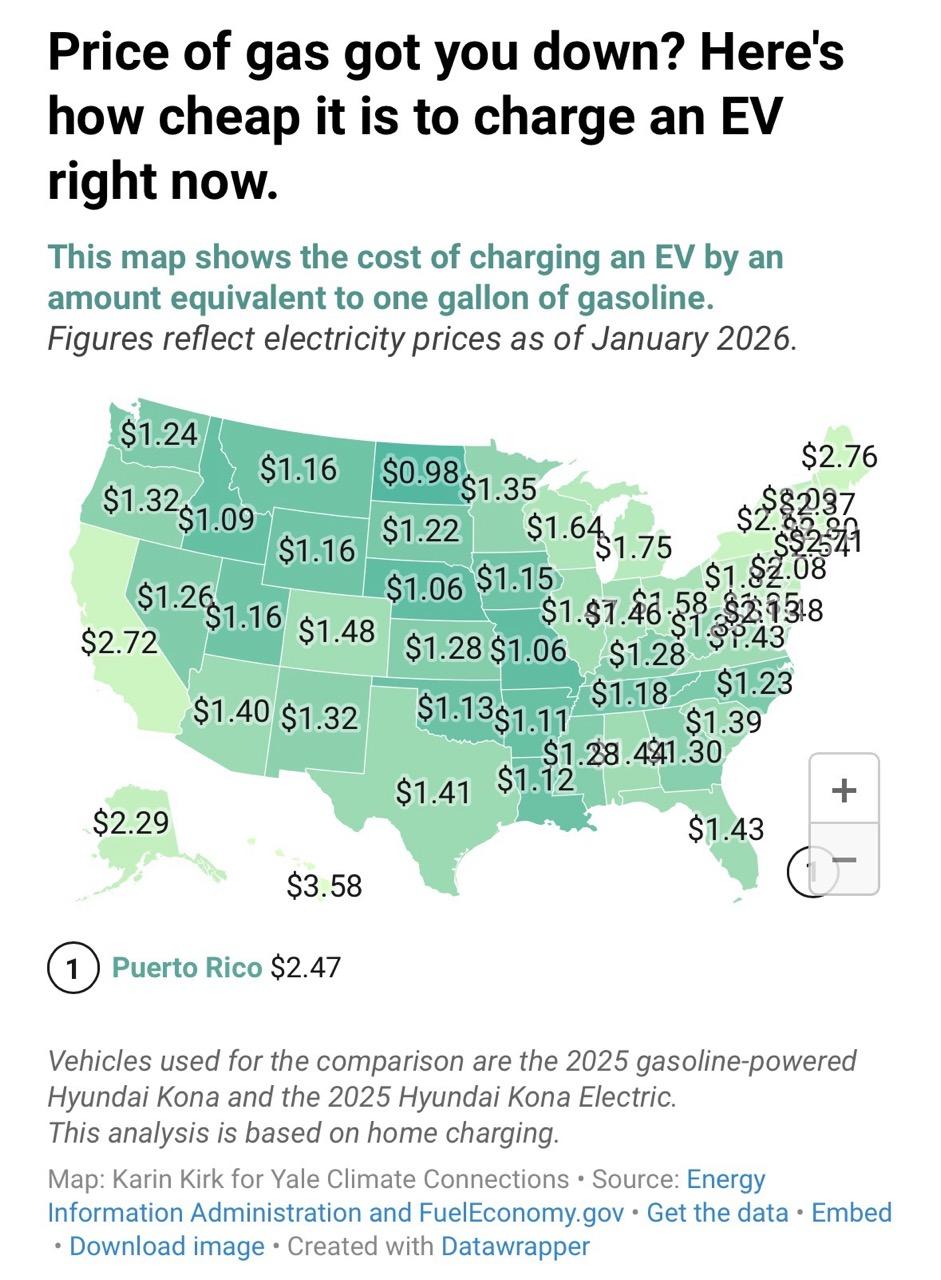
This map shows the cost of charging an EV at home across the U.S.
-
@Sea1Am @noodlemaz @Sheril What's yours? You're in favour of restricting disabled people to their homes? And you know that public transport can be EVs too? Trains, buses, etc. There are reasons for transport which aren't just individual people as well.
Why do you think it's an either/or? And I wouldn't touch a Tesla with a ten foot pole either but he's hardly the only option these days.I must insist you scroll up and look at my original comment. I am quite aware of the fact EVs are not all cars.
Idk what kind of day you are having, but I hope the rest of it goes better.
-
In my ideal world disabled people wouldn't need cars at all. Ever heard of a 15 minute city?
In fact, I would rather people just left cities entirely and lived in small communities taking care of each other like we did before we were all enslaved by people like Elon Musk.
I'm sick of people pretending they're saving the world by buying an electric car, it's a lie.
Stop fooling yourselves. It's pathetic.
@Sea1Am @ariaflame @noodlemaz @Sheril Be the change you want to see in the world. Go live your life in a little communal town. Then once you're there (after you've worked your sustainable farm plot, shorn your sheep, contributed to the community goods, and helped your neighbor build their barn) you can safely scold others on the internet for living unsustainable lives.
-
@Sheril Interesting to see that the only state in which charging an EV is more expensive than in California is in Hawaii. Why is that? What can we do about it?
@ELS @Sheril Because much electricity generation in the US comes from burning fossil fuels, which are costly to import to such an isolated location. And having an interstate connected grid helps offset costs from supply-demand mismatch, which is something Hawaii doesn't have.
ETA: Maine, and I believe New York, are also higher than CA. -
@Sea1Am @noodlemaz @Sheril What's yours? You're in favour of restricting disabled people to their homes? And you know that public transport can be EVs too? Trains, buses, etc. There are reasons for transport which aren't just individual people as well.
Why do you think it's an either/or? And I wouldn't touch a Tesla with a ten foot pole either but he's hardly the only option these days.@ariaflame @Sea1Am @noodlemaz @Sheril There are disabled people who "need" cars, but there are (probably) many more disabled people who can't use cars, and who instead need good public transport and good pedestrian/bicycle infrastructure.
Car societies restrict people in many more ways than they enable people.
-
This map shows the cost of charging an EV at home across the U.S. Home-charging is significantly cheaper in all 50 states than fueling a car with gasoline.
Source: Yale https://yaleclimateconnections.org/2026/04/whats-cheaper-fueling-your-car-with-gas-or-electricity/ #energy #uspol
@Sheril I couldn't find any information in that article about how much electrical energy "equivalent to one gallon of gasoline" is in any useful unit.
-
In my ideal world disabled people wouldn't need cars at all. Ever heard of a 15 minute city?
In fact, I would rather people just left cities entirely and lived in small communities taking care of each other like we did before we were all enslaved by people like Elon Musk.
I'm sick of people pretending they're saving the world by buying an electric car, it's a lie.
Stop fooling yourselves. It's pathetic.
@Sea1Am@mastodon.social @ariaflame@masto.ai @noodlemaz@mstdn.games @Sheril@mastodon.social I live in Las Vegas and everywhere I go is less than 6 miles away. And I should transfer my prescriptions to a closer pharmacy, then my universe would shrink to less than 3 miles.
-
@ariaflame @Sea1Am @noodlemaz @Sheril There are disabled people who "need" cars, but there are (probably) many more disabled people who can't use cars, and who instead need good public transport and good pedestrian/bicycle infrastructure.
Car societies restrict people in many more ways than they enable people.
@ahltorp @Sea1Am @noodlemaz @Sheril We therefore need a mix. Good public transport, but for the times that individual (or group, or for goods transport) vehicle is needed, we want EV versions. We also should have good bike lanes, footpaths for easy walking etc. Better organisation of residential areas so that shops etc. are not long distances away.
-
In my ideal world disabled people wouldn't need cars at all. Ever heard of a 15 minute city?
In fact, I would rather people just left cities entirely and lived in small communities taking care of each other like we did before we were all enslaved by people like Elon Musk.
I'm sick of people pretending they're saving the world by buying an electric car, it's a lie.
Stop fooling yourselves. It's pathetic.
@Sea1Am @noodlemaz @Sheril You were the one implying people thought that. I certainly don't. But it's not a trivial exercise to shift everyone to your perfect community.
In some ways the people who want perfection before they want any change are almost worse than those who don't want any change at all.
But since I want to enjoy the rest of my evening I'll leave it there.
Tomorrow will be soon enough to return to teaching people about energy efficiency, renewable energy etc. -
@ahltorp @Sea1Am @noodlemaz @Sheril We therefore need a mix. Good public transport, but for the times that individual (or group, or for goods transport) vehicle is needed, we want EV versions. We also should have good bike lanes, footpaths for easy walking etc. Better organisation of residential areas so that shops etc. are not long distances away.
@ariaflame @Sea1Am @noodlemaz @Sheril What we really need is a shift to a non-car-centric model. Cars can exist, sure, but they should not be the prioritised mode of transport. Cars should always be treated as the exception, and car-centric design should not be allowed to make using other modes of transport significantly worse.
This is not only about cities, in non-city environments roads have been made unusable for all vulnerable road users in large parts of the world.
-
@ariaflame @Sea1Am @noodlemaz @Sheril What we really need is a shift to a non-car-centric model. Cars can exist, sure, but they should not be the prioritised mode of transport. Cars should always be treated as the exception, and car-centric design should not be allowed to make using other modes of transport significantly worse.
This is not only about cities, in non-city environments roads have been made unusable for all vulnerable road users in large parts of the world.
@ariaflame @Sea1Am @noodlemaz @Sheril Car-centric culture is dependent on threat of violence to keep vulnerable road users off the road. It is vital to car-centric culture that people using roads or streets in ways that slow down car traffic are regularly maimed or killed, in order to instill a high threat level.
This is a very uncomfortable truth, but is easily realised once you actually think about it. Violence against pedestrians and bicycle users is not a side effect.
-
@lemizy @Sheril See Technology Connections' latest video on the topic. It does not have to be "VERY expensive" to charge an EV at home. You can slow charge using a standard US 120V outlet, you can repurpose a dryer outlet. Most people could get by with level 1 (120V) charging for their daily commutes. The bigger issue is that EV charging is not available to most renters in the US and even providing some 120V outlets would go a long way to alleviate this.
@CalcProgrammer1 @lemizy @Sheril Thanks for this, I never thought to use the dryer’s 240v connection in a pinch. Here I’ve been slow charging my Prius overnight all this time.
-
@CalcProgrammer1 @lemizy @Sheril Thanks for this, I never thought to use the dryer’s 240v connection in a pinch. Here I’ve been slow charging my Prius overnight all this time.
@jwd630 @CalcProgrammer1 @lemizy @Sheril there are $300 "auto switcher" power strips that let you plug a drying into one outlet and the level 2 charger into another and it smartly disables the car charging when you turn your dryer on.
With one of these, you can use level 2 charger normally, and dont even need to pull a new electrical circuit. Keeps wear and tear down on the outlet too.
-
@Sea1Am @ariaflame @noodlemaz @Sheril Be the change you want to see in the world. Go live your life in a little communal town. Then once you're there (after you've worked your sustainable farm plot, shorn your sheep, contributed to the community goods, and helped your neighbor build their barn) you can safely scold others on the internet for living unsustainable lives.
@Jumpmed @ariaflame @noodlemaz @Sheril
I am building towards my goal, thanks. I am not rich like Elon Musk, so I can't do it all myself in one day. There is no reason to hold my opinions until I have reached some goal post set by someone who is in denial, and doesn't want to change.
I have made many sacrifices, and I will continue to do so, whether you like it or not.
Have a good day, kiddo.
-
@ariaflame @Sea1Am @noodlemaz @Sheril There are disabled people who "need" cars, but there are (probably) many more disabled people who can't use cars, and who instead need good public transport and good pedestrian/bicycle infrastructure.
Car societies restrict people in many more ways than they enable people.
@ahltorp @ariaflame @noodlemaz @Sheril
Preach baby!
My disabled spouse doesn't appreciate people using her as a token to win silly arguments. My spouse agrees with me on 15 minute cities, and small communities.
-
@Sea1Am@mastodon.social @ariaflame@masto.ai @noodlemaz@mstdn.games @Sheril@mastodon.social I live in Las Vegas and everywhere I go is less than 6 miles away. And I should transfer my prescriptions to a closer pharmacy, then my universe would shrink to less than 3 miles.
@jaypeach53 @Sheril @ariaflame @noodlemaz
Glad to hear you are fighting the good fight, comrade! The more we do locally for ourselves, the better. Thank you.
-
@ahltorp @Sea1Am @noodlemaz @Sheril We therefore need a mix. Good public transport, but for the times that individual (or group, or for goods transport) vehicle is needed, we want EV versions. We also should have good bike lanes, footpaths for easy walking etc. Better organisation of residential areas so that shops etc. are not long distances away.
@ariaflame @ahltorp @noodlemaz @Sheril
Our shortsightedness is causing us to settle for bad solutions. We can't cling to this lifestyle, it's destroying us.
The sea rise is accelerating beyond all the models predictions. The longer we wait, the more drastic our solutions have to be, and we have already kicked this can down the road for too long.
-
@ariaflame @Sea1Am @noodlemaz @Sheril What we really need is a shift to a non-car-centric model. Cars can exist, sure, but they should not be the prioritised mode of transport. Cars should always be treated as the exception, and car-centric design should not be allowed to make using other modes of transport significantly worse.
This is not only about cities, in non-city environments roads have been made unusable for all vulnerable road users in large parts of the world.
@ahltorp @ariaflame @noodlemaz @Sheril
And let's not forget the urban heat island effect. We deserve better.
-
@ariaflame @Sea1Am @noodlemaz @Sheril Car-centric culture is dependent on threat of violence to keep vulnerable road users off the road. It is vital to car-centric culture that people using roads or streets in ways that slow down car traffic are regularly maimed or killed, in order to instill a high threat level.
This is a very uncomfortable truth, but is easily realised once you actually think about it. Violence against pedestrians and bicycle users is not a side effect.
@ahltorp @ariaflame @noodlemaz @Sheril
I've experienced the violence of the road firsthand and I can confirm your statements. I've spent the past 5 or so years taking my electric bike out to work in a rural community, and I've had some close calls.
Let me tell you, biking around in the Canadian winter is not pleasant. But, it was a sacrifice I was more than happy to make to reduce my footprint, and I plan to continue to reduce it further.
Eden, here I come! One step at a time.
-
@ahltorp @ariaflame @noodlemaz @Sheril
I've experienced the violence of the road firsthand and I can confirm your statements. I've spent the past 5 or so years taking my electric bike out to work in a rural community, and I've had some close calls.
Let me tell you, biking around in the Canadian winter is not pleasant. But, it was a sacrifice I was more than happy to make to reduce my footprint, and I plan to continue to reduce it further.
Eden, here I come! One step at a time.
@Sea1Am On a related note, how is the sand/gravel situation where you bike? Here in Sweden both roads and dedicated bike paths are often treated with gravel after snow plowing, but many municipalities are very slow to get rid of the gravel in the spring, leading to many biking injuries and lots of dust inhalation.
Some major urban and suburban bike paths are "sweepsalted", which results in a clean surface, avoiding slippery gravel, but is probably not a reasonable solution for rural roads.
-
This map shows the cost of charging an EV at home across the U.S. Home-charging is significantly cheaper in all 50 states than fueling a car with gasoline.
Source: Yale https://yaleclimateconnections.org/2026/04/whats-cheaper-fueling-your-car-with-gas-or-electricity/ #energy #uspol
We live rural and the lack of charging stations causes hesitation for my husband to even think of getting an EV. However I've worked on convincing him to get a hybrid.