Skip to content
  • Categories
  • Recent
  • Tags
  • Popular
  • World
  • Users
  • Groups
Skins
  • Light
  • Brite
  • Cerulean
  • Cosmo
  • Flatly
  • Journal
  • Litera
  • Lumen
  • Lux
  • Materia
  • Minty
  • Morph
  • Pulse
  • Sandstone
  • Simplex
  • Sketchy
  • Spacelab
  • United
  • Yeti
  • Zephyr
  • Dark
  • Cyborg
  • Darkly
  • Quartz
  • Slate
  • Solar
  • Superhero
  • Vapor

  • Default (Cyborg)
  • No Skin
Collapse
Brand Logo

CIRCLE WITH A DOT

  1. Home
  2. Uncategorized
  3. If you use AI-generated code, you currently cannot claim copyright on it in the US.

If you use AI-generated code, you currently cannot claim copyright on it in the US.

Scheduled Pinned Locked Moved Uncategorized
147 Posts 82 Posters 0 Views
  • Oldest to Newest
  • Newest to Oldest
  • Most Votes
Reply
  • Reply as topic
Log in to reply
This topic has been deleted. Only users with topic management privileges can see it.
  • jaredwhite@indieweb.socialJ jaredwhite@indieweb.social

    @jamie The funny thing about this whole thread is apparently I'd already blocked that guy some time ago, so I'm only seeing your side of the conversation. And…that's all I need to know anyway. 😅

    firepoet@tech.lgbtF This user is from outside of this forum
    firepoet@tech.lgbtF This user is from outside of this forum
    firepoet@tech.lgbt
    wrote last edited by
    #136

    @jaredwhite @jamie Thanks for the tip for another hateful person to block.

    1 Reply Last reply
    0
    • jamie@zomglol.wtfJ jamie@zomglol.wtf

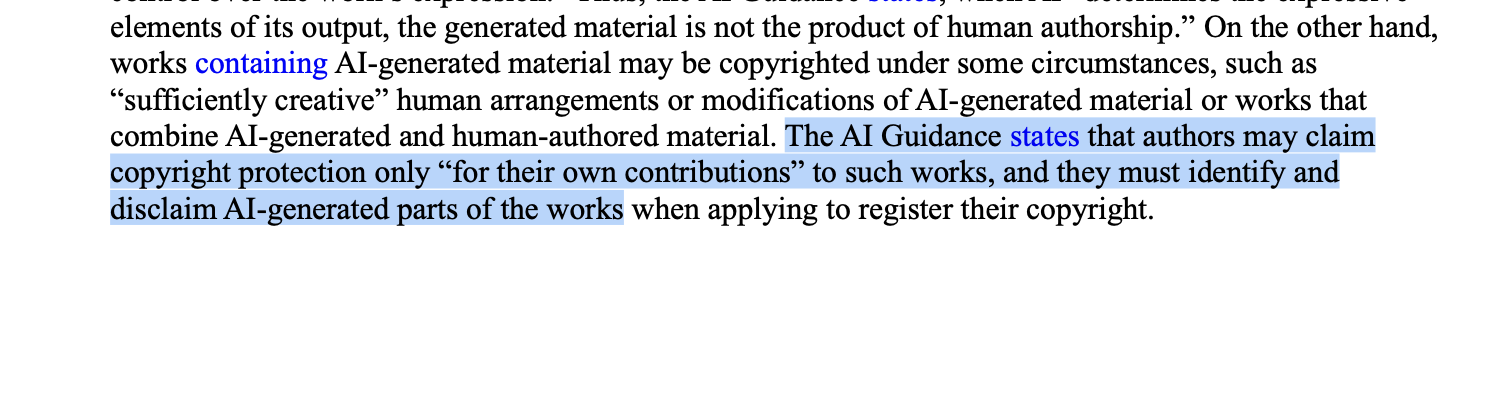
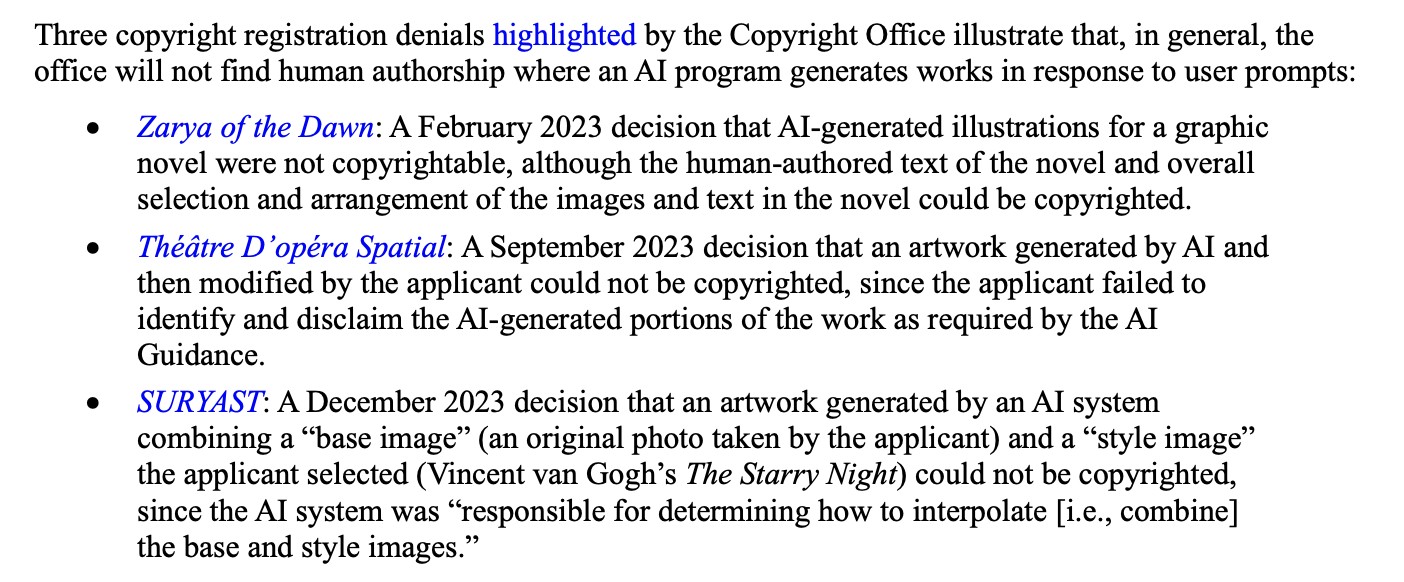
      If you use AI-generated code, you currently cannot claim copyright on it in the US. If you fail to disclose/disclaim exactly which parts were not written by a human, you forfeit your copyright claim on *the entire codebase*.

      This means copyright notices and even licenses folks are putting on their vibe-coded GitHub repos are unenforceable. The AI-generated code, and possibly the whole project, becomes public domain.

      Source: https://www.congress.gov/crs_external_products/LSB/PDF/LSB10922/LSB10922.8.pdf
      Link Preview ImageLink Preview Image
      verxion@mas.toV This user is from outside of this forum
      verxion@mas.toV This user is from outside of this forum
      verxion@mas.to
      wrote last edited by
      #137

      @stroughtonsmith Is this relevant? I honestly don’t know a ton about this but I’m curious if you have thoughts on it…

      stroughtonsmith@mastodon.socialS 1 Reply Last reply
      0
      • jmcs@social.jsantos.euJ jmcs@social.jsantos.eu

        @jamie @Azuaron @fsinn exactly, if law looked only at the content in disk and didn't consider intent then things would become silly very fast. An encrypted copy of Disney's latest movie also doesn't contain the movie by itself, and that never stopped Disney lawyers.

        ptesarik@infosec.exchangeP This user is from outside of this forum
        ptesarik@infosec.exchangeP This user is from outside of this forum
        ptesarik@infosec.exchange
        wrote last edited by
        #138

        @jmcs the only trouble is that you can't use AI to produce Disney-style movies; if you could, AI would have long been dead
        @jamie @Azuaron @fsinn

        jmcs@social.jsantos.euJ 1 Reply Last reply
        0
        • verxion@mas.toV verxion@mas.to

          @stroughtonsmith Is this relevant? I honestly don’t know a ton about this but I’m curious if you have thoughts on it…

          stroughtonsmith@mastodon.socialS This user is from outside of this forum
          stroughtonsmith@mastodon.socialS This user is from outside of this forum
          stroughtonsmith@mastodon.social
          wrote last edited by
          #139

          @Verxion I think this is probably right:

          Nick Lockwood (@nicklockwood@mastodon.social)

          People pontificating about whether codebases containing LLM-generated code are subject to IP protection all seem to be forgetting the key point that the law always sides with capital When big media decided that pirating an mp3 file should be a criminal (not civil) offence, the law sided with them When big tech decided that pirating every piece of media on the internet for AI training was fair use, the law sided with them

          favicon

          Mastodon (mastodon.social)

          verxion@mas.toV 1 Reply Last reply
          0
          • stroughtonsmith@mastodon.socialS stroughtonsmith@mastodon.social

            @Verxion I think this is probably right:

            Nick Lockwood (@nicklockwood@mastodon.social)

            People pontificating about whether codebases containing LLM-generated code are subject to IP protection all seem to be forgetting the key point that the law always sides with capital When big media decided that pirating an mp3 file should be a criminal (not civil) offence, the law sided with them When big tech decided that pirating every piece of media on the internet for AI training was fair use, the law sided with them

            favicon

            Mastodon (mastodon.social)

            verxion@mas.toV This user is from outside of this forum
            verxion@mas.toV This user is from outside of this forum
            verxion@mas.to
            wrote last edited by
            #140

            @stroughtonsmith I think that’s fair. I seriously do and so I’m not disagreeing with you.

            …the sad thing though (to me anyway) is that this means an indie dev is unlikely to be able to afford to retain ownership like a large corporation can. 😞

            1 Reply Last reply
            0
            • jamie@zomglol.wtfJ jamie@zomglol.wtf

              If you use AI-generated code, you currently cannot claim copyright on it in the US. If you fail to disclose/disclaim exactly which parts were not written by a human, you forfeit your copyright claim on *the entire codebase*.

              This means copyright notices and even licenses folks are putting on their vibe-coded GitHub repos are unenforceable. The AI-generated code, and possibly the whole project, becomes public domain.

              Source: https://www.congress.gov/crs_external_products/LSB/PDF/LSB10922/LSB10922.8.pdf
              Link Preview ImageLink Preview Image
              jik@federate.socialJ This user is from outside of this forum
              jik@federate.socialJ This user is from outside of this forum
              jik@federate.social
              wrote last edited by
              #141

              @jamie I am afraid you are confusing registering copyright with the existence of copyright. They are not quite the same, and the differences are important.
              Current law is that any human-created work is automatically copyrighted the moment it is created.
              The link and screenshots you posted aren't about whether the human-written code mixed in with AI-written code is copyrighted—it is—they're about whether the copyright can be _registered_.
              (1/2)

              jik@federate.socialJ 1 Reply Last reply
              0
              • jik@federate.socialJ jik@federate.social

                @jamie I am afraid you are confusing registering copyright with the existence of copyright. They are not quite the same, and the differences are important.
                Current law is that any human-created work is automatically copyrighted the moment it is created.
                The link and screenshots you posted aren't about whether the human-written code mixed in with AI-written code is copyrighted—it is—they're about whether the copyright can be _registered_.
                (1/2)

                jik@federate.socialJ This user is from outside of this forum
                jik@federate.socialJ This user is from outside of this forum
                jik@federate.social
                wrote last edited by
                #142

                @jamie A copyrighted work that isn't registered is still copyrighted. It's not "in the public domain."
                Registration, in the U.S., allows for certain copyright enforcement actions that can't be taken for unregistered works. But whether or not a work is registered has no bearing on whether it is copyrighted vs. in the public domain.
                (2/2)

                1 Reply Last reply
                0
                • ptesarik@infosec.exchangeP ptesarik@infosec.exchange

                  @jmcs the only trouble is that you can't use AI to produce Disney-style movies; if you could, AI would have long been dead
                  @jamie @Azuaron @fsinn

                  jmcs@social.jsantos.euJ This user is from outside of this forum
                  jmcs@social.jsantos.euJ This user is from outside of this forum
                  jmcs@social.jsantos.eu
                  wrote last edited by
                  #143

                  @ptesarik @jamie @Azuaron @fsinn is that a challenge?

                  ptesarik@infosec.exchangeP 1 Reply Last reply
                  0
                  • jmcs@social.jsantos.euJ jmcs@social.jsantos.eu

                    @ptesarik @jamie @Azuaron @fsinn is that a challenge?

                    ptesarik@infosec.exchangeP This user is from outside of this forum
                    ptesarik@infosec.exchangeP This user is from outside of this forum
                    ptesarik@infosec.exchange
                    wrote last edited by
                    #144

                    @jmcs you bet!
                    @jamie @Azuaron @fsinn

                    1 Reply Last reply
                    0
                    • jamie@zomglol.wtfJ jamie@zomglol.wtf

                      If you use AI-generated code, you currently cannot claim copyright on it in the US. If you fail to disclose/disclaim exactly which parts were not written by a human, you forfeit your copyright claim on *the entire codebase*.

                      This means copyright notices and even licenses folks are putting on their vibe-coded GitHub repos are unenforceable. The AI-generated code, and possibly the whole project, becomes public domain.

                      Source: https://www.congress.gov/crs_external_products/LSB/PDF/LSB10922/LSB10922.8.pdf

                      Link Preview ImageLink Preview Image
                      taschenorakel@mastodon.greenT This user is from outside of this forum
                      taschenorakel@mastodon.greenT This user is from outside of this forum
                      taschenorakel@mastodon.green
                      wrote last edited by
                      #145

                      @jamie Just waiting for someone finding derivates of their own GPL code in propritary AI generated code...

                      1 Reply Last reply
                      0
                      • fsinn@mas.toF fsinn@mas.to

                        @jamie I *am* an IP lawyer and I (along with many others) have been saying it for a while, that if the position the “AI” co’s are taking with respect to the legality of scraping “publicly available” materials were true (that all “publicly available” materials are “public domain” free to be used as raw materials without consent required), then copyright ceases to exist and all their own materials will be free for everyone else to use the very first time they’re leaked. That’ll be fun for the co.

                        pettter@social.accum.seP This user is from outside of this forum
                        pettter@social.accum.seP This user is from outside of this forum
                        pettter@social.accum.se
                        wrote last edited by
                        #146

                        @fsinn I am in general in favour of "copyright ceases to exist" tbh since that is in practise the case for most individuals. @jamie

                        1 Reply Last reply
                        0
                        • jamie@zomglol.wtfJ jamie@zomglol.wtf

                          If you use AI-generated code, you currently cannot claim copyright on it in the US. If you fail to disclose/disclaim exactly which parts were not written by a human, you forfeit your copyright claim on *the entire codebase*.

                          This means copyright notices and even licenses folks are putting on their vibe-coded GitHub repos are unenforceable. The AI-generated code, and possibly the whole project, becomes public domain.

                          Source: https://www.congress.gov/crs_external_products/LSB/PDF/LSB10922/LSB10922.8.pdf

                          Link Preview ImageLink Preview Image
                          srazkvt@tech.lgbtS This user is from outside of this forum
                          srazkvt@tech.lgbtS This user is from outside of this forum
                          srazkvt@tech.lgbt
                          wrote last edited by
                          #147

                          @jamie so proprietary projects that are made with llms can be leaked legally since there's no copyright for it ?

                          1 Reply Last reply
                          0
                          • pixelate@tweesecake.socialP pixelate@tweesecake.social shared this topic

                          Reply
                          • Reply as topic
                          Log in to reply
                          • Oldest to Newest
                          • Newest to Oldest
                          • Most Votes


                          • Login

                          • Login or register to search.
                          • First post
                            Last post
                          0
                          • Categories
                          • Recent
                          • Tags
                          • Popular
                          • World
                          • Users
                          • Groups