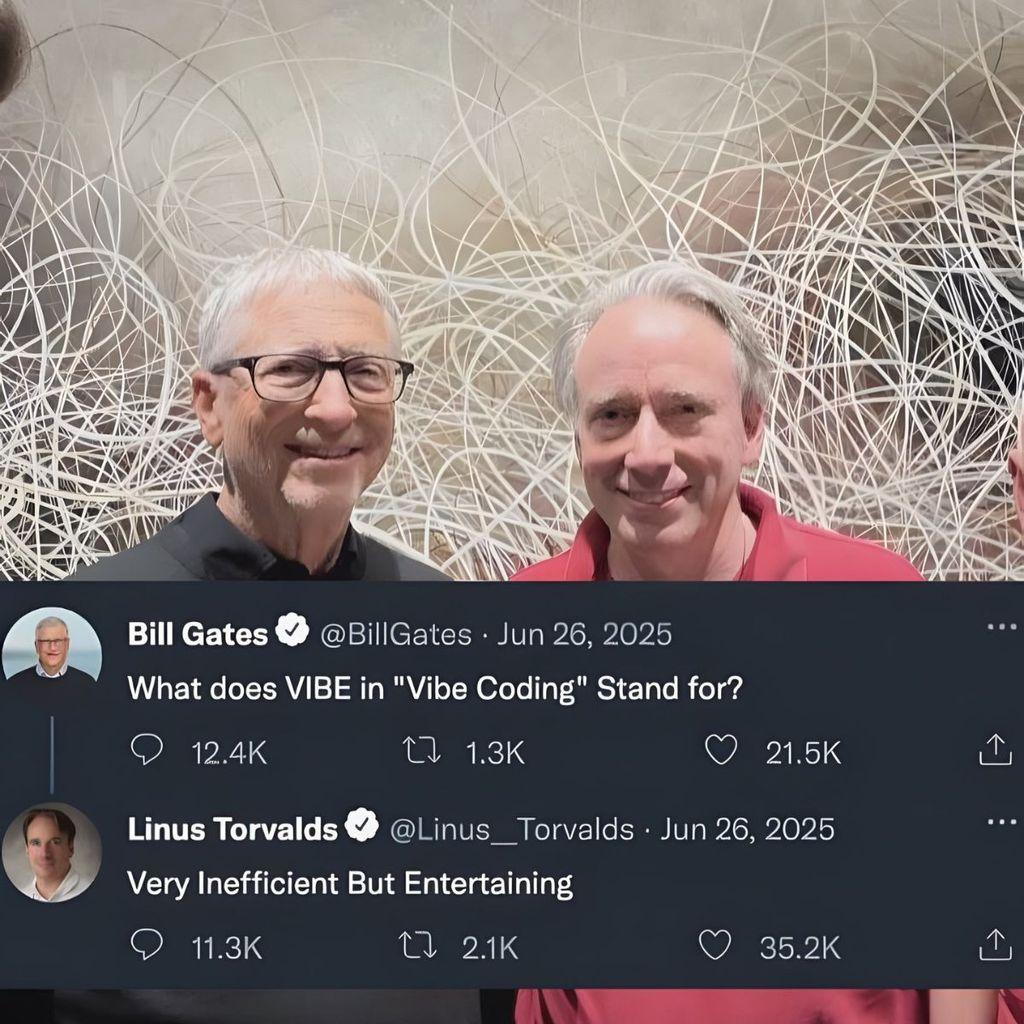
Linus Torvalds, the legend 🔥
-
@itsfoss They DO belong together those two. 🤮
-
Linus Torvalds, the legend

@itsfoss he is also vibecoding shit now, just not the kernel iirc
-
@itsfoss he is also vibecoding shit now, just not the kernel iirc
-
Linus Torvalds, the legend
@itsfoss Mr Gates, congratulations. Your planted agent LP has f******d Linux successfully!
-
Linus Torvalds, the legend
@itsfoss it’s very much not entertaining though, it’s burning the planet
-
Linus Torvalds, the legend
@itsfoss Bill Gates raped children on Epstein Island.
-
Linus Torvalds, the legend
Torvalds is like a soccer player who comes on in the 75th minute when the score is 1-1. His team is called Alice-Team, the opponent is Bill-Team.
He plays well for 15 minutes, works hard out there, and scores the winning goal, for a 2-1 victory. Alice-Team fans rejoice. Bill-Team fans, sad.
Imagine an interview a couple of days after the match.
INTERVIEWER: fans are saying you basically won the whole match, and the victory should even be named after you, Linus' victory. Journalists are writing the story of this match as if all that happened is one person arrived out of nowhere and won a game. What do you say to those people?
TORVALDS: oh, I don't do politics. People can say what they like. I just chase the ball and kick it.
==============
Cultural context: soccer ("football", to some) is an 11-person-a-side 90-minute team sport, where the team with the most goals at the end wins. Fans of teams tend to dislike when players are selfish and egotistical, and tend to adore players who recognise the team effort, and put their individual effort in the context of the team effort.
Disclaimer: This comment is about *all* the GNU people, and all the not-that-GNU people who still contributed to those sorts of ideas and all that work around that time; *not* any one individual. For example, I personally have a particular fondness for the late Bob Chassell, of "An Introduction to Programming in Emacs Lisp" fame.
Conclusion: (i) why must we adulate individuals, sigh, and (ii) why do we let programmer types off the hook so easily when they play the "Oh I'm a computer-person, I'm not aware that politics and culture exists" card, also sigh
-
Torvalds is like a soccer player who comes on in the 75th minute when the score is 1-1. His team is called Alice-Team, the opponent is Bill-Team.
He plays well for 15 minutes, works hard out there, and scores the winning goal, for a 2-1 victory. Alice-Team fans rejoice. Bill-Team fans, sad.
Imagine an interview a couple of days after the match.
INTERVIEWER: fans are saying you basically won the whole match, and the victory should even be named after you, Linus' victory. Journalists are writing the story of this match as if all that happened is one person arrived out of nowhere and won a game. What do you say to those people?
TORVALDS: oh, I don't do politics. People can say what they like. I just chase the ball and kick it.
==============
Cultural context: soccer ("football", to some) is an 11-person-a-side 90-minute team sport, where the team with the most goals at the end wins. Fans of teams tend to dislike when players are selfish and egotistical, and tend to adore players who recognise the team effort, and put their individual effort in the context of the team effort.
Disclaimer: This comment is about *all* the GNU people, and all the not-that-GNU people who still contributed to those sorts of ideas and all that work around that time; *not* any one individual. For example, I personally have a particular fondness for the late Bob Chassell, of "An Introduction to Programming in Emacs Lisp" fame.
Conclusion: (i) why must we adulate individuals, sigh, and (ii) why do we let programmer types off the hook so easily when they play the "Oh I'm a computer-person, I'm not aware that politics and culture exists" card, also sigh
Are we talking about Linus Torvalds, the person who does not follow GNU coding standards at all?
There are all kinds of hard coded limits in Linux, for instance. I had to completely change the design of something after running into this with overlay fs.
And lately he blew his top at other people who wanted to submit some code for big-endian architectures, because HE, Linus Torvalds, has let people commit code to the kernel that is little endian-only.
Oh, he’s a legend, alright
-
Are we talking about Linus Torvalds, the person who does not follow GNU coding standards at all?
There are all kinds of hard coded limits in Linux, for instance. I had to completely change the design of something after running into this with overlay fs.
And lately he blew his top at other people who wanted to submit some code for big-endian architectures, because HE, Linus Torvalds, has let people commit code to the kernel that is little endian-only.
Oh, he’s a legend, alright
-
Linus Torvalds, the legend
@itsfoss Somewhat ironic that the screenshot has telltale signs of being genai...
Mind to provide link the source as should be the norm for good journalism? -
Are we talking about Linus Torvalds, the person who does not follow GNU coding standards at all?
There are all kinds of hard coded limits in Linux, for instance. I had to completely change the design of something after running into this with overlay fs.
And lately he blew his top at other people who wanted to submit some code for big-endian architectures, because HE, Linus Torvalds, has let people commit code to the kernel that is little endian-only.
Oh, he’s a legend, alright
@chemoelectric @jbc @itsfoss I wouldn't say that. Torvalds has indicated that he does not like to be involved in the naming matter himself, but does consider usage of GNU/Linux or Linux/GNU to be more professional when talking about the combination.
-
@chemoelectric @jbc @itsfoss I wouldn't say that. Torvalds has indicated that he does not like to be involved in the naming matter himself, but does consider usage of GNU/Linux or Linux/GNU to be more professional when talking about the combination.
I was talking about the coding standards, which say that there should be no hard coded limits.
Linux is not a GNU project and so is not subject to the coding standards, but that does not make it hunky-dory that Linux does not follow the standards. It is the de facto kernel for GNU systems and so is used by people like myself who prefer GNU coding standards over hard limits.
And I see no excuse for letting people just plaster in code endian or alignment sensitive.
-
I was talking about the coding standards, which say that there should be no hard coded limits.
Linux is not a GNU project and so is not subject to the coding standards, but that does not make it hunky-dory that Linux does not follow the standards. It is the de facto kernel for GNU systems and so is used by people like myself who prefer GNU coding standards over hard limits.
And I see no excuse for letting people just plaster in code endian or alignment sensitive.
-
@chemoelectric @jbc @itsfoss I see, I would say that the popularity of Linux does speak for it, but indeed I'm not technical enough to judge such aspects. I think from the perspective of Torvalds, at this point hardware design and support should tailor Linux instead of the other way around. This is different from how it used to be and where nowadays other kernels might become more interesting.
Given the recent HURD improvements, possibly it will become an interesting contender down the line.
-
@chemoelectric @jbc @itsfoss I see, I would say that the popularity of Linux does speak for it, but indeed I'm not technical enough to judge such aspects. I think from the perspective of Torvalds, at this point hardware design and support should tailor Linux instead of the other way around. This is different from how it used to be and where nowadays other kernels might become more interesting.
Given the recent HURD improvements, possibly it will become an interesting contender down the line.
@jschwart Torvalds is one of the people who has driven women out of the field.
I do not believe in popularity as a determiner of merit. Linux sucks and should not determine hardware. It is x86-centric precisely because its code quality sucks.
So also Rust sucks and people should not waste time on it. They should instead upgrade their code to C23. If they actually cared about code security they would have switched to Ada long ago. They are switching to Rust only because it is a fad.
-
@jschwart Torvalds is one of the people who has driven women out of the field.
I do not believe in popularity as a determiner of merit. Linux sucks and should not determine hardware. It is x86-centric precisely because its code quality sucks.
So also Rust sucks and people should not waste time on it. They should instead upgrade their code to C23. If they actually cared about code security they would have switched to Ada long ago. They are switching to Rust only because it is a fad.
@jschwart Anyway, these folk want to support PowerPC as a legacy system, not as a competitor with AMD64. PowerPC is a 32-bit CPU, after all. I used to program for it on AIX and Solaris. It is big-endian and requires strict alignment. It is a RISC design and is very fast. To program for it is educational.
People who learn only on Intel/AMD architectures are being cheated. They don’t even learn how to program well on THOSE architectures. It is ADVANTAGEOUS to adhere to alignment rules on them.
-
@jschwart Anyway, these folk want to support PowerPC as a legacy system, not as a competitor with AMD64. PowerPC is a 32-bit CPU, after all. I used to program for it on AIX and Solaris. It is big-endian and requires strict alignment. It is a RISC design and is very fast. To program for it is educational.
People who learn only on Intel/AMD architectures are being cheated. They don’t even learn how to program well on THOSE architectures. It is ADVANTAGEOUS to adhere to alignment rules on them.
@chemoelectric how do you see ARM in that light? Regarding Solaris/SPARC I do have an old Ultra 5 here. Would you suggest I look at learning it's assembly language? (That would be for one future day though, I'm afraid not soon...)
You seem to have a lot of experience and it's interesting to see both our family names like that

-
@chemoelectric how do you see ARM in that light? Regarding Solaris/SPARC I do have an old Ultra 5 here. Would you suggest I look at learning it's assembly language? (That would be for one future day though, I'm afraid not soon...)
You seem to have a lot of experience and it's interesting to see both our family names like that
@jschwart I don’t know ARM nor PowerPC nor SPARC. (Maybe I am wrong about what was on that Sun. But the AIX box was a PowerPC and it was easily our fastest machine.) I don’t know the assembly languages.
The only assembly language I ever knew WELL was Z80/8080. I could do 8086 decently at one time, too.
20-something years ago I worked in porting AS/400 Command Language code (which tied together RPG programs) to POSIX machines. The data had to be binary compatible across architectures...
-
@jschwart I don’t know ARM nor PowerPC nor SPARC. (Maybe I am wrong about what was on that Sun. But the AIX box was a PowerPC and it was easily our fastest machine.) I don’t know the assembly languages.
The only assembly language I ever knew WELL was Z80/8080. I could do 8086 decently at one time, too.
20-something years ago I worked in porting AS/400 Command Language code (which tied together RPG programs) to POSIX machines. The data had to be binary compatible across architectures...
@jschwart I do not remember whether we stored the data big endian or little endian. Probably big endian, because I think HP was the ‘Ur-Host’ and it was big endian. Windows and (after I ported to it) GNU/Linux on x86 were probably our only little endian platforms.
But even then the alignment rules were different. Once I found a bug and had to stick some extra padding in a struct and tell people that on a certain architecture the old files were binary incompatible.
-
@jschwart I do not remember whether we stored the data big endian or little endian. Probably big endian, because I think HP was the ‘Ur-Host’ and it was big endian. Windows and (after I ported to it) GNU/Linux on x86 were probably our only little endian platforms.
But even then the alignment rules were different. Once I found a bug and had to stick some extra padding in a struct and tell people that on a certain architecture the old files were binary incompatible.
@jschwart I have been disabled for over 20 years now but have written things like hash function packages and made sure they followed alignment rules and endianness. Though I can test only on AMD64.
As for my family name, my great grandfather was that rare thing, a Jewish baseball player, LOL: https://www.rollbamaroll.com/2018/8/4/17648800/the-curious-case-of-schwartz-alabama-crimson-tide-mystery-1906-baseball-coach