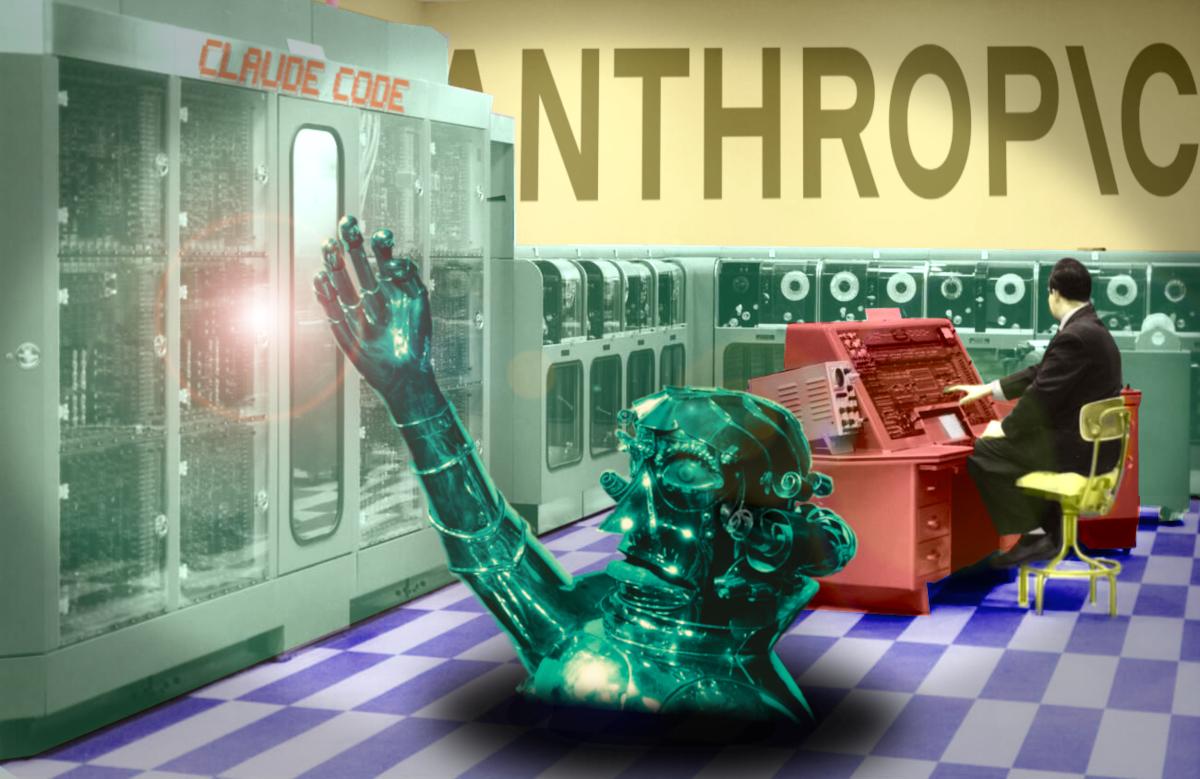
Anthropic's developers made an extremely basic configuration error, and as a result, the source-code for Claude Code - the company's flagship coding assistant product - has leaked and is being eagerly analyzed by many parties:
-
The stakes couldn't be higher, in other words. Diebold - whose CEO was an avowed GW Bush partisan who'd promised to "deliver the votes for Bush" - was the country's leading voting machine supplier.
9/
The company knew its voting machines were defective, that they frequently crashed and lost their vote counts on election night, and that Diebold technicians were colluding with local electoral officials to secretly "estimate" the lost vote totals so that no one would hold either the official or Diebold responsible for these defective machines:
An open invitation to election fraud - Salon.com
Not only is the country's leading touch-screen voting system so badly designed that votes can be easily changed, but its manufacturer is run by a die-hard GOP donor who vowed to deliver his state for Bush next year.

Salon.com (www.salon.com)
10/
-
The company knew its voting machines were defective, that they frequently crashed and lost their vote counts on election night, and that Diebold technicians were colluding with local electoral officials to secretly "estimate" the lost vote totals so that no one would hold either the official or Diebold responsible for these defective machines:
An open invitation to election fraud - Salon.com
Not only is the country's leading touch-screen voting system so badly designed that votes can be easily changed, but its manufacturer is run by a die-hard GOP donor who vowed to deliver his state for Bush next year.
Salon.com (www.salon.com)
10/
Diebold sent *thousands* of DMCA 512 takedown notices in an attempt to suppress the leaked memos. Eventually, EFF stepped in to provide pro-bono counsel to the Online Policy Group and ended Diebold's flood:

Online Policy Group v. Diebold
EFF protected online speakers by bringing the first successful suit against abusive copyright claims under the Digital Millennium Copyright Act (DMCA). When internal memos exposing flaws in Diebold Election Systems' electronic voting machines leaked onto the Internet, Diebold used bogus copyright threats to silence its critics. EFF fought back on behalf of an ISP, winning an
Electronic Frontier Foundation (www.eff.org)
Diebold wasn't the last company to figure out how to abuse copyright to censor information of high public interest.
11/
-
Diebold sent *thousands* of DMCA 512 takedown notices in an attempt to suppress the leaked memos. Eventually, EFF stepped in to provide pro-bono counsel to the Online Policy Group and ended Diebold's flood:
Online Policy Group v. Diebold
EFF protected online speakers by bringing the first successful suit against abusive copyright claims under the Digital Millennium Copyright Act (DMCA). When internal memos exposing flaws in Diebold Election Systems' electronic voting machines leaked onto the Internet, Diebold used bogus copyright threats to silence its critics. EFF fought back on behalf of an ISP, winning an
Electronic Frontier Foundation (www.eff.org)
Diebold wasn't the last company to figure out how to abuse copyright to censor information of high public interest.
11/
There's a whole industry of shady "reputation management" companies that collect large sums in exchange for scrubbing the internet of information their clients want removed from the public eye. They specialize in sexual abusers, war criminals, torturers, and fraudsters, and their weapon of choice is the takedown notice. Jeffrey Epstein spent tens of thousands of dollars on "reputation management" services to clean up his online profile:
12/
-
There's a whole industry of shady "reputation management" companies that collect large sums in exchange for scrubbing the internet of information their clients want removed from the public eye. They specialize in sexual abusers, war criminals, torturers, and fraudsters, and their weapon of choice is the takedown notice. Jeffrey Epstein spent tens of thousands of dollars on "reputation management" services to clean up his online profile:
12/
There are lots of ways to use the takedown system to get true information about your crimes removed from the internet. My favorite is the one employed by Eliminalia, one of the sleazier reputation laundries (even by the industry's dismal standards).
Eliminalia sets up Wordpress sites and copies press articles that cast its clients in an unfavorable light to these sites, backdating them so they appear to have been published before the originals.
13/
-
There are lots of ways to use the takedown system to get true information about your crimes removed from the internet. My favorite is the one employed by Eliminalia, one of the sleazier reputation laundries (even by the industry's dismal standards).
Eliminalia sets up Wordpress sites and copies press articles that cast its clients in an unfavorable light to these sites, backdating them so they appear to have been published before the originals.
13/
They swap out the bylines for fictitious ones, then send takedowns to Google and other search engines to get the "infringing" stories purged from their search indices. Once the original articles have been rendered invisible to internet searchers, Eliminalia takes down their copy, and the story of their client's war crimes, rapes, or fraud disappears from the public eye:
14/
-
They swap out the bylines for fictitious ones, then send takedowns to Google and other search engines to get the "infringing" stories purged from their search indices. Once the original articles have been rendered invisible to internet searchers, Eliminalia takes down their copy, and the story of their client's war crimes, rapes, or fraud disappears from the public eye:
14/
The takedown system is so tilted in favor of censorship that it takes a *massive* effort to keep even the smallest piece of information online in the face of a determined adversary. In 2007, the key for AACS (a way of encrypting video for "digital rights management") leaked online. The key was a 16-digit number, the kind of thing you could fit in a crossword puzzle, but the position of the industry consortium that created the key was that this was an *illegal integer*.
15/
-
The takedown system is so tilted in favor of censorship that it takes a *massive* effort to keep even the smallest piece of information online in the face of a determined adversary. In 2007, the key for AACS (a way of encrypting video for "digital rights management") leaked online. The key was a 16-digit number, the kind of thing you could fit in a crossword puzzle, but the position of the industry consortium that created the key was that this was an *illegal integer*.
15/
They sent *hundreds of thousands* of takedowns over the number, and it was only the determined action of an army of users that kept the number online:
The shoot-first, ask-questions-never nature of takedown notices makes for fertile ground for scammers of all kinds, but the most ironic takedown ripoffs are the Youtube copystrike blackmailers.
16/
-
They sent *hundreds of thousands* of takedowns over the number, and it was only the determined action of an army of users that kept the number online:
The shoot-first, ask-questions-never nature of takedown notices makes for fertile ground for scammers of all kinds, but the most ironic takedown ripoffs are the Youtube copystrike blackmailers.
16/
After Viacom sued Youtube in 2007 over copyright infringement, Google launched its own in-house copyright management system, meant to address Viacom's principal grievance in the suit. Viacom was angry that after they had something removed from Youtube, another user could re-upload it, and they'd have to send another takedown, playing Wack-a-Mole with the whole internet.
17/
-
After Viacom sued Youtube in 2007 over copyright infringement, Google launched its own in-house copyright management system, meant to address Viacom's principal grievance in the suit. Viacom was angry that after they had something removed from Youtube, another user could re-upload it, and they'd have to send another takedown, playing Wack-a-Mole with the whole internet.
17/
Viacom didn't want a *takedown* system, they wanted a *staydown* system, whereby they could supply Google with a list of the works whose copyrights they controlled and then Youtube would prevent *anyone* from uploading those works.
18/
-
Viacom didn't want a *takedown* system, they wanted a *staydown* system, whereby they could supply Google with a list of the works whose copyrights they controlled and then Youtube would prevent *anyone* from uploading those works.
18/
(This was extremely funny, because Viacom admitted in court that its marketing departments would "rough up" clips of its programming and upload them to Youtube, making them appear to be pirate copies, in a bid to interest Youtube users in Viacom's shows, and sometimes Viacom's lawyers would get confused and send threatening letters to Youtube demanding that these be removed:)
19/
-
(This was extremely funny, because Viacom admitted in court that its marketing departments would "rough up" clips of its programming and upload them to Youtube, making them appear to be pirate copies, in a bid to interest Youtube users in Viacom's shows, and sometimes Viacom's lawyers would get confused and send threatening letters to Youtube demanding that these be removed:)
19/
Youtube's notice-and-staydown system is Content ID, an incredibly baroque system that allows copyright holders (and people pretending to be copyright holders) to "claim" video and sound files, and block others from posting them. No one - not even the world's leading copyright experts - can figure out how to use this system to uphold copyright:
20/
-
Youtube's notice-and-staydown system is Content ID, an incredibly baroque system that allows copyright holders (and people pretending to be copyright holders) to "claim" video and sound files, and block others from posting them. No one - not even the world's leading copyright experts - can figure out how to use this system to uphold copyright:
20/
However, there *is* a large cohort of criminals and fraudsters who have mastered Content ID and they use it to blackmail independent artists. You see, Content ID implements a "three strikes" policy: if you are accused of three acts of copyright infringement, Youtube permanently deletes your videos and bars you from the platform.
21/
-
However, there *is* a large cohort of criminals and fraudsters who have mastered Content ID and they use it to blackmail independent artists. You see, Content ID implements a "three strikes" policy: if you are accused of three acts of copyright infringement, Youtube permanently deletes your videos and bars you from the platform.
21/
For performers who rely on Youtube to earn their living - whether through ad-revenues or sponsorships or as a promotional vehicle to sell merchandise, recordings and tickets - the "copystrike" is an existential risk.
Enter the fraudster. A fraudster can set up multiple burner Youtube accounts and file spurious copyright complaints against a creator (usually a musician).
22/
-
For performers who rely on Youtube to earn their living - whether through ad-revenues or sponsorships or as a promotional vehicle to sell merchandise, recordings and tickets - the "copystrike" is an existential risk.
Enter the fraudster. A fraudster can set up multiple burner Youtube accounts and file spurious copyright complaints against a creator (usually a musician).
22/
After two of these copystrikes are accepted and the performer is just one strike away from losing their livelihood, the fraudster contacts the performer and demands blackmail money to rescind the complaints, threatening to file that final strike and put the performer out of business:
23/
-
After two of these copystrikes are accepted and the performer is just one strike away from losing their livelihood, the fraudster contacts the performer and demands blackmail money to rescind the complaints, threatening to file that final strike and put the performer out of business:
23/
The fact that copyright - nominally a system intended to protect creative workers - is weaponized against the people it is meant to serve is ironic, but it's not unusual. Copyright law has been primarily shaped by creators' *bosses* - media companies like Viacom - who brandish "starving artists" as a reason to enact policies that ultimately benefit capital at the expense of labor.
24/
-
The fact that copyright - nominally a system intended to protect creative workers - is weaponized against the people it is meant to serve is ironic, but it's not unusual. Copyright law has been primarily shaped by creators' *bosses* - media companies like Viacom - who brandish "starving artists" as a reason to enact policies that ultimately benefit capital at the expense of labor.
24/
That was what inspired Rebecca Giblin and I to write our 2022 book *Chokepoint Capitalism*: how is it that copyright has expanded in every way for 40 years (longer duration, wider scope, higher penalties), resulting in media companies that are more profitable than ever, with higher gross *and* net revenues, even as creative workers have grown poorer, both in total compensation and in the share of the profits they generate?
https://chokepointcapitalism.com/
25/
-
That was what inspired Rebecca Giblin and I to write our 2022 book *Chokepoint Capitalism*: how is it that copyright has expanded in every way for 40 years (longer duration, wider scope, higher penalties), resulting in media companies that are more profitable than ever, with higher gross *and* net revenues, even as creative workers have grown poorer, both in total compensation and in the share of the profits they generate?
https://chokepointcapitalism.com/
25/
The first half of *Chokepoint Capitalism* is a series of case studies that dissect the frauds and scams that both media and tech companies use to steal from creative workers. The second half are a series of "shovel-ready" policy proposals for new laws and rules that would actually put money in artists' pockets. Some of these policy prescriptions are copyright-related, but not all of them.
26/
-
The first half of *Chokepoint Capitalism* is a series of case studies that dissect the frauds and scams that both media and tech companies use to steal from creative workers. The second half are a series of "shovel-ready" policy proposals for new laws and rules that would actually put money in artists' pockets. Some of these policy prescriptions are copyright-related, but not all of them.
26/
For example, we have a chapter on how the Hollywood "guild" system (which allows unionized workers to bargain with *all* the studios at once) has been a powerful antidote to corporate power. This is called "sectoral bargaining" and it's been illegal since 1947's Taft-Hartley Act, but the Hollywood guilds were grandfathered in.
27/
-
For example, we have a chapter on how the Hollywood "guild" system (which allows unionized workers to bargain with *all* the studios at once) has been a powerful antidote to corporate power. This is called "sectoral bargaining" and it's been illegal since 1947's Taft-Hartley Act, but the Hollywood guilds were grandfathered in.
27/
When we wrote about the power of sectoral bargaining, it was in reference to the Writers Guild's incredible triumph over the four giant talent agencies, who'd invented a scam that inverted the traditional revenue split between writer and agent, so the agencies were taking in *90%* and the writers were getting just *10%*:
28/
-
When we wrote about the power of sectoral bargaining, it was in reference to the Writers Guild's incredible triumph over the four giant talent agencies, who'd invented a scam that inverted the traditional revenue split between writer and agent, so the agencies were taking in *90%* and the writers were getting just *10%*:
28/
Two years later, the Hollywood Writers struck again, this time over AI in the writers' room, securing a *stunning* victory over the major studios:
Notably, the writers strike was a *labor* action, not a copyright action. The writers weren't demanding a new copyright that would allow them to control whether their work could be used to train an AI.
29/