Skip to content
  • Categories
  • Recent
  • Tags
  • Popular
  • World
  • Users
  • Groups
Skins
  • Light
  • Brite
  • Cerulean
  • Cosmo
  • Flatly
  • Journal
  • Litera
  • Lumen
  • Lux
  • Materia
  • Minty
  • Morph
  • Pulse
  • Sandstone
  • Simplex
  • Sketchy
  • Spacelab
  • United
  • Yeti
  • Zephyr
  • Dark
  • Cyborg
  • Darkly
  • Quartz
  • Slate
  • Solar
  • Superhero
  • Vapor

  • Default (Cyborg)
  • No Skin
Collapse
Brand Logo

CIRCLE WITH A DOT

  1. Home
  2. Uncategorized
  3. Quick!

Quick!

Scheduled Pinned Locked Moved Uncategorized
14 Posts 11 Posters 0 Views
  • Oldest to Newest
  • Newest to Oldest
  • Most Votes
Reply
  • Reply as topic
Log in to reply
This topic has been deleted. Only users with topic management privileges can see it.
  • michael@westergaard.socialM michael@westergaard.social
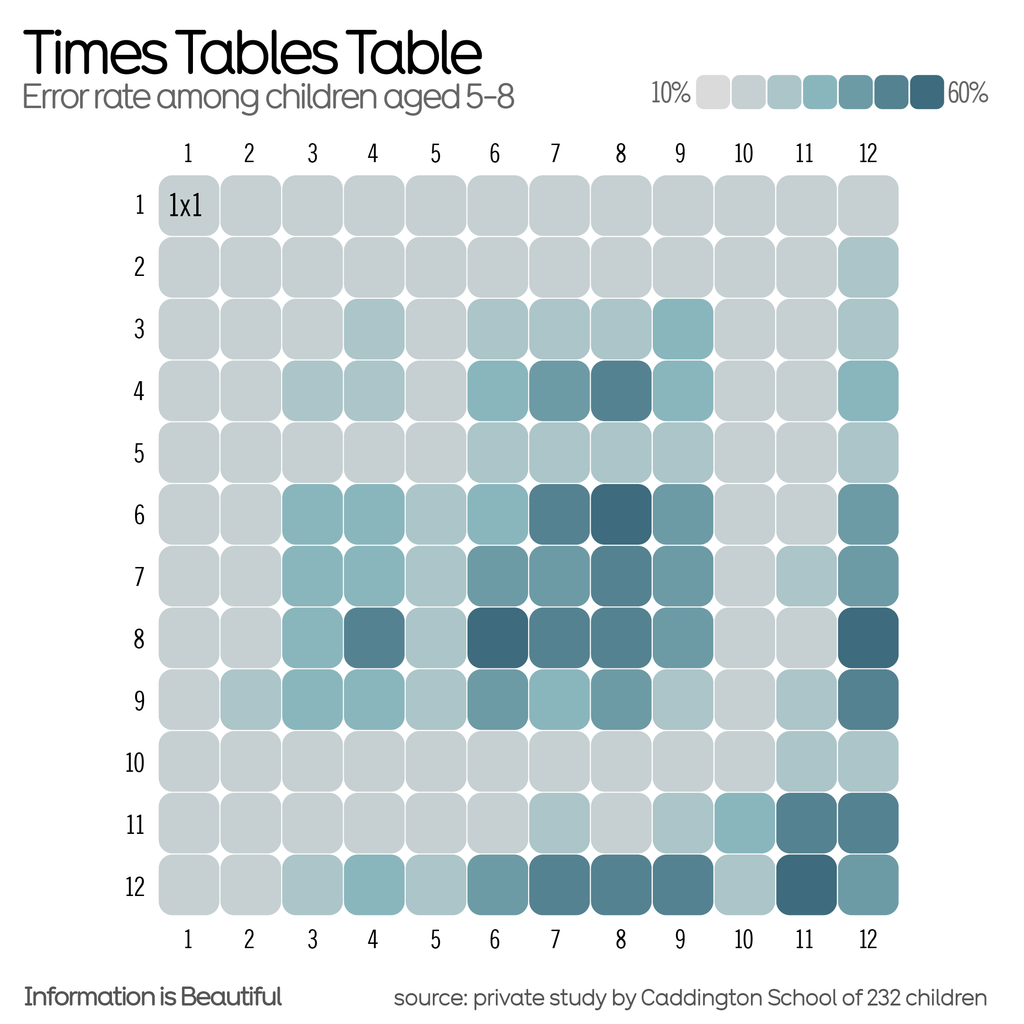
    The base part is it’s not 100% symmetrical along the diagonal
    kasperd@westergaard.socialK This user is from outside of this forum
    kasperd@westergaard.socialK This user is from outside of this forum
    kasperd@westergaard.social
    wrote last edited by
    #5

    I noticed that as well and think that's an interesting result. The asymmetry tells us something about how kids learn to multiply, though I am not sure what that something is.

    michael@westergaard.socialM 1 Reply Last reply
    1
    0
    • R relay@relay.infosec.exchange shared this topic
    • infobeautiful@vis.socialI infobeautiful@vis.social

      Quick! What's 6 x 8? 7 x 6? The trickiest multiplications for kids aged 5-8. How many do you still struggle with?
      Link Preview Image
      falcennial@mastodon.socialF This user is from outside of this forum
      falcennial@mastodon.socialF This user is from outside of this forum
      falcennial@mastodon.social
      wrote last edited by
      #6

      @infobeautiful why does 8×12 have a much lower than 12×8 💀

      1 Reply Last reply
      0
      • om@witter.czO om@witter.cz

        @infobeautiful
        It is unclear in which order the coefficients were assigned (since the table is not symmetrical) and the 1x1 legend does not really help here 🙂

        falcennial@mastodon.socialF This user is from outside of this forum
        falcennial@mastodon.socialF This user is from outside of this forum
        falcennial@mastodon.social
        wrote last edited by
        #7

        @om @infobeautiful yeah. I took it as alphabetical order of axis x then y.

        1 Reply Last reply
        0
        • kasperd@westergaard.socialK kasperd@westergaard.social

          I noticed that as well and think that's an interesting result. The asymmetry tells us something about how kids learn to multiply, though I am not sure what that something is.

          michael@westergaard.socialM This user is from outside of this forum
          michael@westergaard.socialM This user is from outside of this forum
          michael@westergaard.social
          wrote last edited by
          #8
          Multiplication of small numbers is pure memorization. So this tells us they learn one ordering more than the other.
          michael@westergaard.socialM 1 Reply Last reply
          0
          • michael@westergaard.socialM michael@westergaard.social
            Multiplication of small numbers is pure memorization. So this tells us they learn one ordering more than the other.
            michael@westergaard.socialM This user is from outside of this forum
            michael@westergaard.socialM This user is from outside of this forum
            michael@westergaard.social
            wrote last edited by
            #9
            I know I remember 6 * 8 = 48 as "both end in 8." That rule doesn't work for 8 * 6, making that a harder operation.
            1 Reply Last reply
            0
            • infobeautiful@vis.socialI infobeautiful@vis.social

              Quick! What's 6 x 8? 7 x 6? The trickiest multiplications for kids aged 5-8. How many do you still struggle with?

              Link Preview Image
              wish@sk.unix.dogW This user is from outside of this forum
              wish@sk.unix.dogW This user is from outside of this forum
              wish@sk.unix.dog
              wrote last edited by
              #10

              @infobeautiful@vis.social The most evil thing about this chart to me is that it's not symmetrical

              1 Reply Last reply
              0
              • infobeautiful@vis.socialI infobeautiful@vis.social

                Quick! What's 6 x 8? 7 x 6? The trickiest multiplications for kids aged 5-8. How many do you still struggle with?

                Link Preview Image
                heckinchonker@mastodon.socialH This user is from outside of this forum
                heckinchonker@mastodon.socialH This user is from outside of this forum
                heckinchonker@mastodon.social
                wrote last edited by
                #11

                @infobeautiful Is this suggesting that 10% of kids get 1x1 incorrect?

                1 Reply Last reply
                0
                • infobeautiful@vis.socialI infobeautiful@vis.social

                  Quick! What's 6 x 8? 7 x 6? The trickiest multiplications for kids aged 5-8. How many do you still struggle with?

                  Link Preview Image
                  rickyx@fosstodon.orgR This user is from outside of this forum
                  rickyx@fosstodon.orgR This user is from outside of this forum
                  rickyx@fosstodon.org
                  wrote last edited by
                  #12

                  @infobeautiful to master 7x8 you can reverse the whole equation:
                  56=7x8.
                  For my children it is easy to remember 5678 and now, no problem!

                  1 Reply Last reply
                  0
                  • infobeautiful@vis.socialI infobeautiful@vis.social

                    Quick! What's 6 x 8? 7 x 6? The trickiest multiplications for kids aged 5-8. How many do you still struggle with?

                    Link Preview Image
                    johan@s.cafeJ This user is from outside of this forum
                    johan@s.cafeJ This user is from outside of this forum
                    johan@s.cafe
                    wrote last edited by
                    #13

                    @infobeautiful

                    Very strange. In which schools is it in which country? The multiplication table is usually learned at the age of 8-9, isn't it?

                    hcf@infosec.exchangeH 1 Reply Last reply
                    0
                    • johan@s.cafeJ johan@s.cafe

                      @infobeautiful

                      Very strange. In which schools is it in which country? The multiplication table is usually learned at the age of 8-9, isn't it?

                      hcf@infosec.exchangeH This user is from outside of this forum
                      hcf@infosec.exchangeH This user is from outside of this forum
                      hcf@infosec.exchange
                      wrote last edited by
                      #14

                      @johan @infobeautiful The infographics says 232 children were studied at Caddington School, possibly the one in the suburbs of London.

                      1 Reply Last reply
                      1
                      0
                      Reply
                      • Reply as topic
                      Log in to reply
                      • Oldest to Newest
                      • Newest to Oldest
                      • Most Votes


                      • Login

                      • Login or register to search.
                      • First post
                        Last post
                      0
                      • Categories
                      • Recent
                      • Tags
                      • Popular
                      • World
                      • Users
                      • Groups