
Ever struggled to explain “Linux fragmentation” to non‑tech friends?
-
Ever struggled to explain “Linux fragmentation” to non‑tech friends?


You’re chatting with friends, family, or a non‑technical manager and the question lands:
“Why are we using Red Hat at work when my friend uses Ubuntu at home? Aren’t they both just Linux? Why is this so complicated?”
Explaining a modular, kernel‑based world to someone used to one neat product (macOS, Windows, iOS) can feel like explaining car mechanics at a dinner party.
So how do you make it click?
Here’s an analogy I’ve used for years that usually gets an instant “Aha!” from non‑tech people.
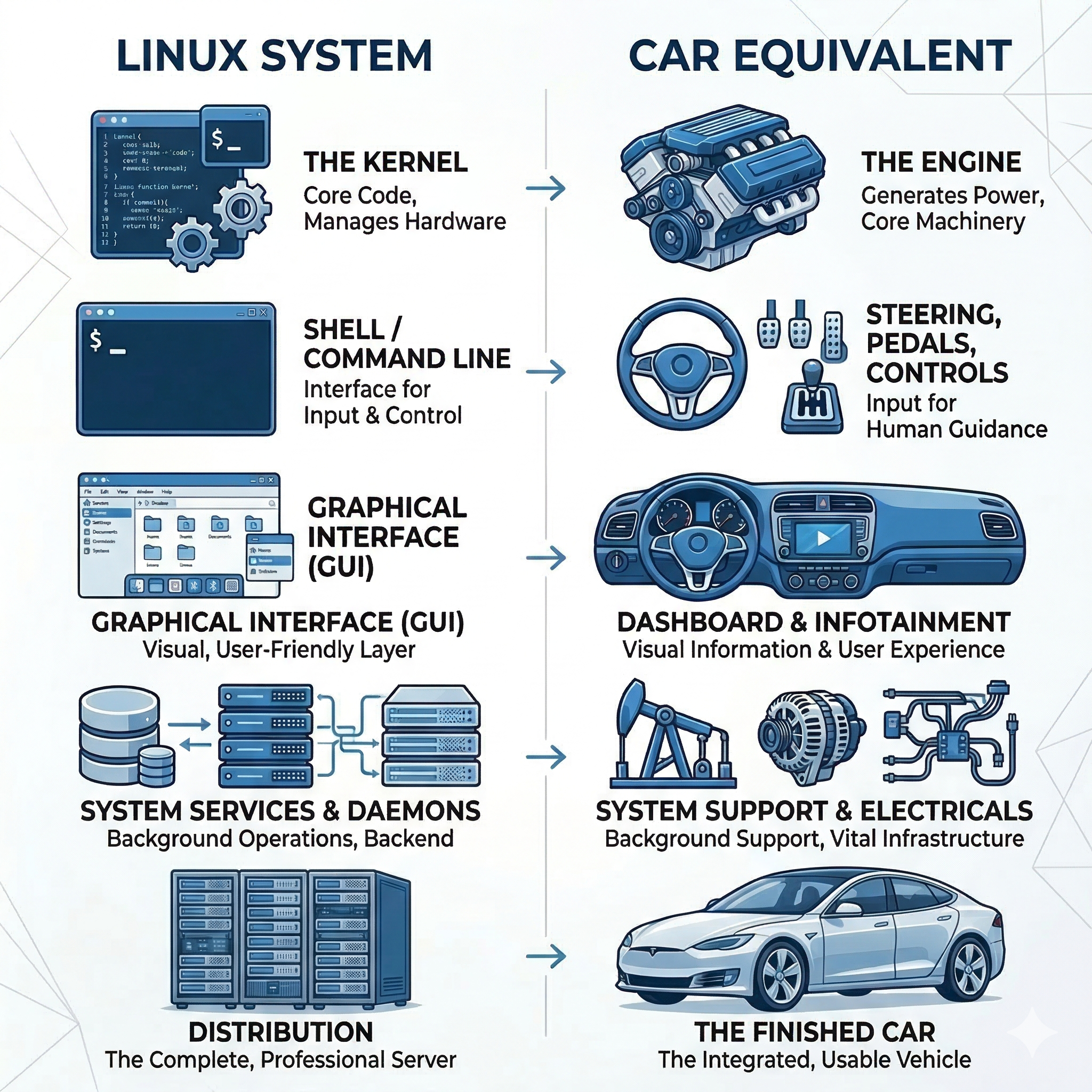
Engine vs. Vehicle
 Kernel = Engine
The Linux kernel is the engine: the core machinery that actually makes things run. It’s powerful and reliable – but an engine alone doesn’t get you anywhere. Distro = Vehicle
A distribution (distro) is the whole vehicle built around that engine: body, seats, dashboard, storage, tools. It’s the engine plus everything else you need to actually use it, assembled for a particular purpose.And just like in real life, we don’t pick a vehicle because of the paint job; we pick it because of what we need it to do.
Everyday Examples
To pull it out of the “enterprise IT” bubble, I frame it with everyday roles. The Commercial Truck (Server) – RHEL, Debian
A big truck that hauls heavy loads non‑stop. Not designed for comfort or looks, just for doing the job, reliably, for years. That’s your server: often no GUI, older but proven components, maximum stability. The Daily Driver (Workstation) – Fedora, Ubuntu LTS
Your normal car: comfortable, up‑to‑date, good enough for commuting, shopping, road trips. That’s a developer or desktop distro: modern tools, stable enough for everyday work and testing. ️ The Specialist Van (Niche Distros) – Kali Linux
A van packed with custom tools for a single trade – like a locksmith’s or electrician’s van. You don’t use it for everything; you use it when you need that specific toolkit. That’s a security‑focused distro.
So is this “fragmentation”?
“They all share the same core engine, but the ‘vehicles’ are customized for different jobs. Servers, laptops, and security toolkits all run Linux – just tuned differently.”Same engine, different roles:
• long‑running servers,
• everyday work machines,
• highly specialized tools.Your Turn
How do you explain the “many Linuxes” problem to people who aren’t in IT – friends at a bar, parents, or colleagues from non‑tech teams?
Drop your best analogies and stories below

#Linux #OpenSource #DevOps #SystemAdministration #CloudComputing #TechCommunication #EverydayTech
-
R relay@relay.infosec.exchange shared this topic
