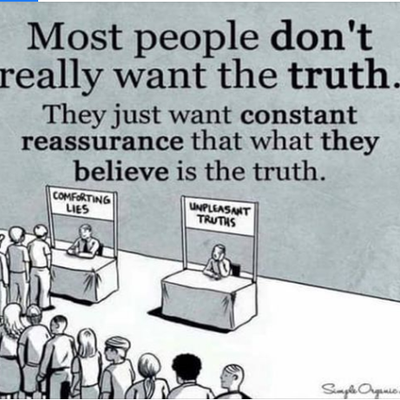
The teacher said "In English a double negative forms a positive.
-
The teacher said "In English a double negative forms a positive. In some languages, though, such as Russian, a double negative is still a negative. However, there is no language wherein a double positive can form a negative."
A voice from the back of the room piped up, "Yeah, right."This phrase is part of the language in Aotearoa New Zealand.
-
English is my second language and phrases like
"we don't want no education"
always bother me.
@rzeta0 You and Pink Floyd too!

-
@kibcol1049 here with my relevant username.
-
@rzeta0 You and Pink Floyd too!
innit
-
English is my second language and phrases like
"we don't want no education"
always bother me.
@rzeta0 @kibcol1049 Recursive joke, innit.
-
@rzeta0 @kibcol1049 Recursive joke, innit.
@rzeta0 @kibcol1049 (Like "a little knowledge is a dangerous thing." (Pope actually said "a little *learning* is a dangerous thing."))
-
@rzeta0 @kibcol1049 (Like "a little knowledge is a dangerous thing." (Pope actually said "a little *learning* is a dangerous thing."))
@rzeta0 @kibcol1049 (But that one is usually inadvertent. Pink Floyd did it on purpose.)
-
The claim I have seen is that version of "right" derives from "hwaet", which was how a spoken story was opened, loosly meaning "pay attention" or, loosely, "wake up at the back." It's how "Beowulf" opens.
@Wolf_Baginski @kibcol1049 But Spanish has a similar expression: "Sí, claro", with the same negative meaning.
What happens is here irony acts, and that's why the meaning changes; it's not a syntax thing, like the double negative stuff. -
@rzeta0 @kibcol1049 apparently the double negative thing is a convention rather than a hard rule. Double negative can make a sentence more klunky (sound awkward) and it is usually better to try and remove it busy most people simply would not care.
@EF @rzeta0 @kibcol1049
A common issue in language learning/linguistics is how any given language uses double negatives and negative questions. -
@rzeta0 @kibcol1049 apparently the double negative thing is a convention rather than a hard rule. Double negative can make a sentence more klunky (sound awkward) and it is usually better to try and remove it busy most people simply would not care.
@EF @rzeta0 @kibcol1049 "I ain't not never doin' that no sir." Rolls right off the tongue.
-
@EF @rzeta0 @kibcol1049
A common issue in language learning/linguistics is how any given language uses double negatives and negative questions.@HighlandLawyer @rzeta0 @kibcol1049 absolutely but in common speech, being understood and questioning where it is not clear, is easier. Am not a linguist so grammatical nuances are not my finest hour. I ask a lot of questions.
-
@EF @rzeta0 @kibcol1049 "I ain't not never doin' that no sir." Rolls right off the tongue.
@fgbjr @rzeta0 @kibcol1049 no never not init!

-
@fgbjr @rzeta0 @kibcol1049 no never not init!
@EF I say no nay never, no nay never no more
-
@Wolf_Baginski @kibcol1049 But Spanish has a similar expression: "Sí, claro", with the same negative meaning.
What happens is here irony acts, and that's why the meaning changes; it's not a syntax thing, like the double negative stuff.@eleder @Wolf_Baginski @kibcol1049 In German, you can express something analogous with "Ja, nee, klar" ("Yes, naa, sure"), i.e. yes-no-yes.
What do you make of that?
-
@eleder @Wolf_Baginski @kibcol1049 In German, you can express something analogous with "Ja, nee, klar" ("Yes, naa, sure"), i.e. yes-no-yes.
What do you make of that?
-
R relay@relay.infosec.exchange shared this topic
-
@eleder @Wolf_Baginski @kibcol1049 In German, you can express something analogous with "Ja, nee, klar" ("Yes, naa, sure"), i.e. yes-no-yes.
What do you make of that?
@jack @Wolf_Baginski @kibcol1049
Spanish also employs expressions like "Sí, no, sí", for example when asked a negative question: "Tú no vas a traer el libro, verdad?" (You're not going to bring the book, right?) -
English is my second language and phrases like
"we don't want no education"
always bother me.
This line is using a children choir and voicing the children's point of view, playing on the double meaning.
They say they don't need education in such a clunky way, confirming that they clearly need education.
-
The teacher said "In English a double negative forms a positive. In some languages, though, such as Russian, a double negative is still a negative. However, there is no language wherein a double positive can form a negative."
A voice from the back of the room piped up, "Yeah, right."@kibcol1049 Reminds me of an old programmer joke:
A wife sends her programmer husband to the grocery store for a loaf of bread...
On his way out she says "and if they have eggs, get a dozen". The programmer husband returns home with 12 loaves of bread and says: "They had eggs."
-
R relay@relay.mycrowd.ca shared this topic
-
@jack @Wolf_Baginski @kibcol1049
Spanish also employs expressions like "Sí, no, sí", for example when asked a negative question: "Tú no vas a traer el libro, verdad?" (You're not going to bring the book, right?)@eleder @jack @Wolf_Baginski @kibcol1049
That's opening a totally different can of worm about how to respond to a negative question!!!
"Are you not finishing that?"
Does "yes" means "I will finish it" or "your statement is correct, I will not finish it".
I've learnt recently that French uses "si" (I will finish it) instead of "yes" (your statement is correct, i will not finish it) to answer a negative question. Native French speaker myself, I feel a bit ashamed about not knowing it before.
-
@eleder @Wolf_Baginski @kibcol1049 In German, you can express something analogous with "Ja, nee, klar" ("Yes, naa, sure"), i.e. yes-no-yes.
What do you make of that?
@Wolf_Baginski @kibcol1049 @eleder @jack reminds me of the old board game Drunter und Drüber with the Jeeiin voting card.














 🫣
🫣