Skip to content
  • Categories
  • Recent
  • Tags
  • Popular
  • World
  • Users
  • Groups
Skins
  • Light
  • Brite
  • Cerulean
  • Cosmo
  • Flatly
  • Journal
  • Litera
  • Lumen
  • Lux
  • Materia
  • Minty
  • Morph
  • Pulse
  • Sandstone
  • Simplex
  • Sketchy
  • Spacelab
  • United
  • Yeti
  • Zephyr
  • Dark
  • Cyborg
  • Darkly
  • Quartz
  • Slate
  • Solar
  • Superhero
  • Vapor

  • Default (Cyborg)
  • No Skin
Collapse
Brand Logo

CIRCLE WITH A DOT

  1. Home
  2. Uncategorized
  3. AI was supposed to make us work less.

AI was supposed to make us work less.
Scheduled Pinned Locked Moved Uncategorized
futureofworkproductivityburnout
1 Posts 1 Posters 0 Views
  • Oldest to Newest
  • Newest to Oldest
  • Most Votes
Reply
  • Reply as topic
Log in to reply
This topic has been deleted. Only users with topic management privileges can see it.
  • romanoroth@fosstodon.orgR This user is from outside of this forum
    romanoroth@fosstodon.orgR This user is from outside of this forum
    romanoroth@fosstodon.org
    wrote last edited by
    #1

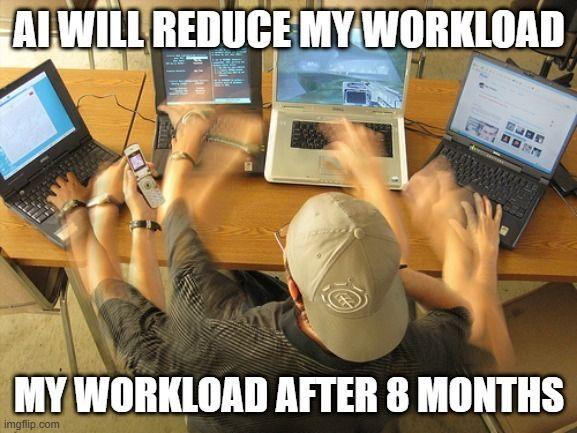
    AI was supposed to make us work less. Instead, it's making us work more.

    An 8-month UC Berkeley study found: AI tools don't reduce workload, they intensify it. Workers took on more tasks, blurred work/life boundaries, and juggled more threads than ever.

    Nobody asked them to. AI just made "doing more" feel possible. Until burnout hit.

    The fix isn't more tools. It's more discipline around the tools we have.

    Link Preview Image
    AI Doesn’t Reduce Work—It Intensifies It

    One of the promises of AI is that it can reduce workloads so employees can focus more on higher-value and more engaging tasks. But according to new research, AI tools don’t reduce work, they consistently intensify it: In the study, employees worked at a faster pace, took on a broader scope of tasks, and extended work into more hours of the day, often without being asked to do so. That may sound like a win, but it’s not quite so simple. These changes can be unsustainable, leading to workload creep, cognitive fatigue, burnout, and weakened decision-making. The productivity surge enjoyed at the beginning can give way to lower quality work, turnover, and other problems. To correct for this, companies need to adopt an “AI practice,” or a set of norms and standards around AI use that can include intentional pauses, sequencing work, and adding more human grounding.

    favicon

    Harvard Business Review (hbr.org)

    #AI #FutureOfWork #Productivity #Burnout

    1 Reply Last reply
    0
    Reply
    • Reply as topic
    Log in to reply
    • Oldest to Newest
    • Newest to Oldest
    • Most Votes


    • Login

    • Login or register to search.
    • First post
      Last post
    0
    • Categories
    • Recent
    • Tags
    • Popular
    • World
    • Users
    • Groups