Happy Pi Day 🥧 And Happy Birthday to Albert Einstein.
-
Happy Pi Day 🥧
And Happy Birthday to Albert Einstein.Here are a few mathematical representations of π developed over the ages. Can you identify the mathematicians behind these equations?
Pi (π) is the ratio of a circle's circumference to its diameter. It is an irrational, transcendental number; its decimal digits continue infinitely without repeating.
π = 3.1415926535 8979323846 2643383279 5028841971 6939937510 ...
https://en.wikipedia.org/wiki/Pi_Day
https://en.wikipedia.org/wiki/Pi
#PiDay2026 #PiDay
1/n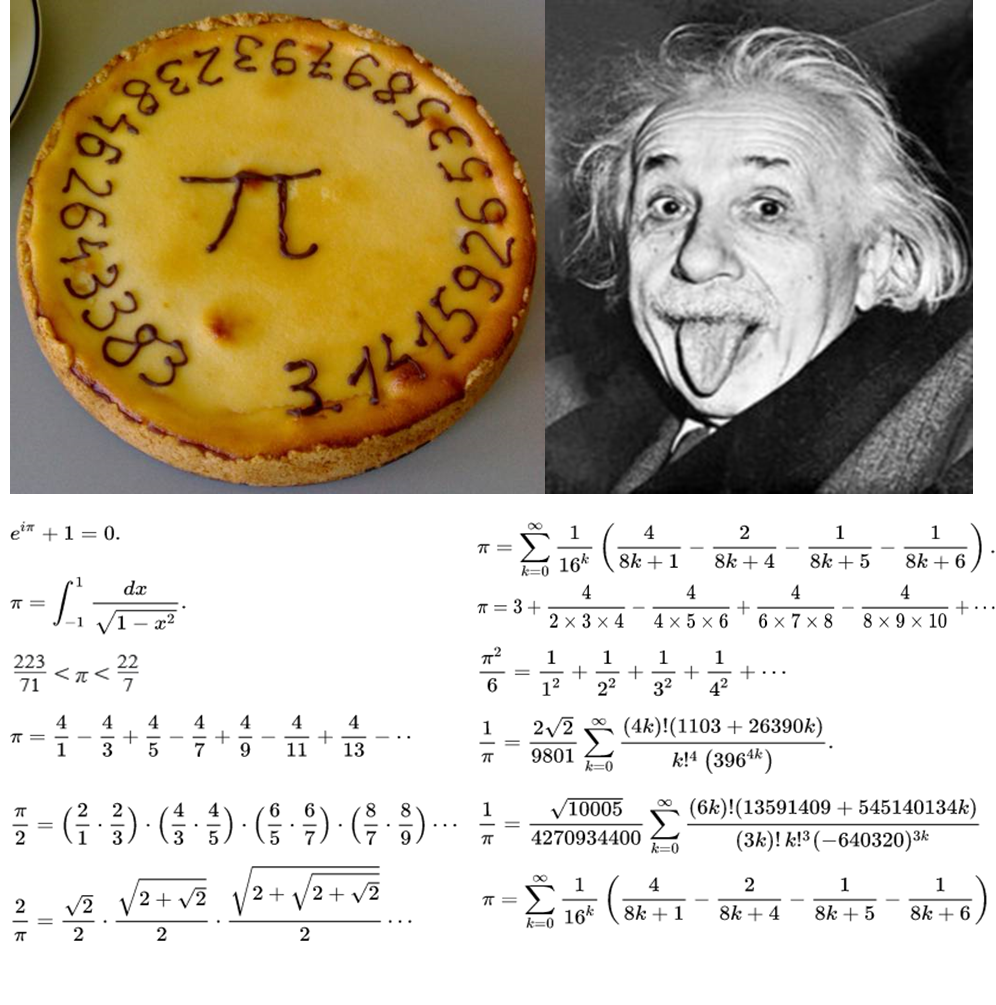
-
R relay@relay.infosec.exchange shared this topic
-
Happy Pi Day 🥧
And Happy Birthday to Albert Einstein.Here are a few mathematical representations of π developed over the ages. Can you identify the mathematicians behind these equations?
Pi (π) is the ratio of a circle's circumference to its diameter. It is an irrational, transcendental number; its decimal digits continue infinitely without repeating.
π = 3.1415926535 8979323846 2643383279 5028841971 6939937510 ...
https://en.wikipedia.org/wiki/Pi_Day
https://en.wikipedia.org/wiki/Pi
#PiDay2026 #PiDay
1/nNASA uses a value of π = 3.141592653589793 with 15 decimal digits for interplanetary navigation.
Calculating the circumference of the circle with radius = 32 billion km, slightly larger than the distance of the Voyager 1 spacecraft, and π with 15 digits, gives an error of just 1.5 cm.
Calculating the circumference of the Universe with radius = 46 billion light years, with an accuracy equal to the diameter of a hydrogen atom, requires 37 decimal digits.

https://www.jpl.nasa.gov/edu/news/how-many-decimals-of-pi-do-we-really-need/
#PiDay
2/n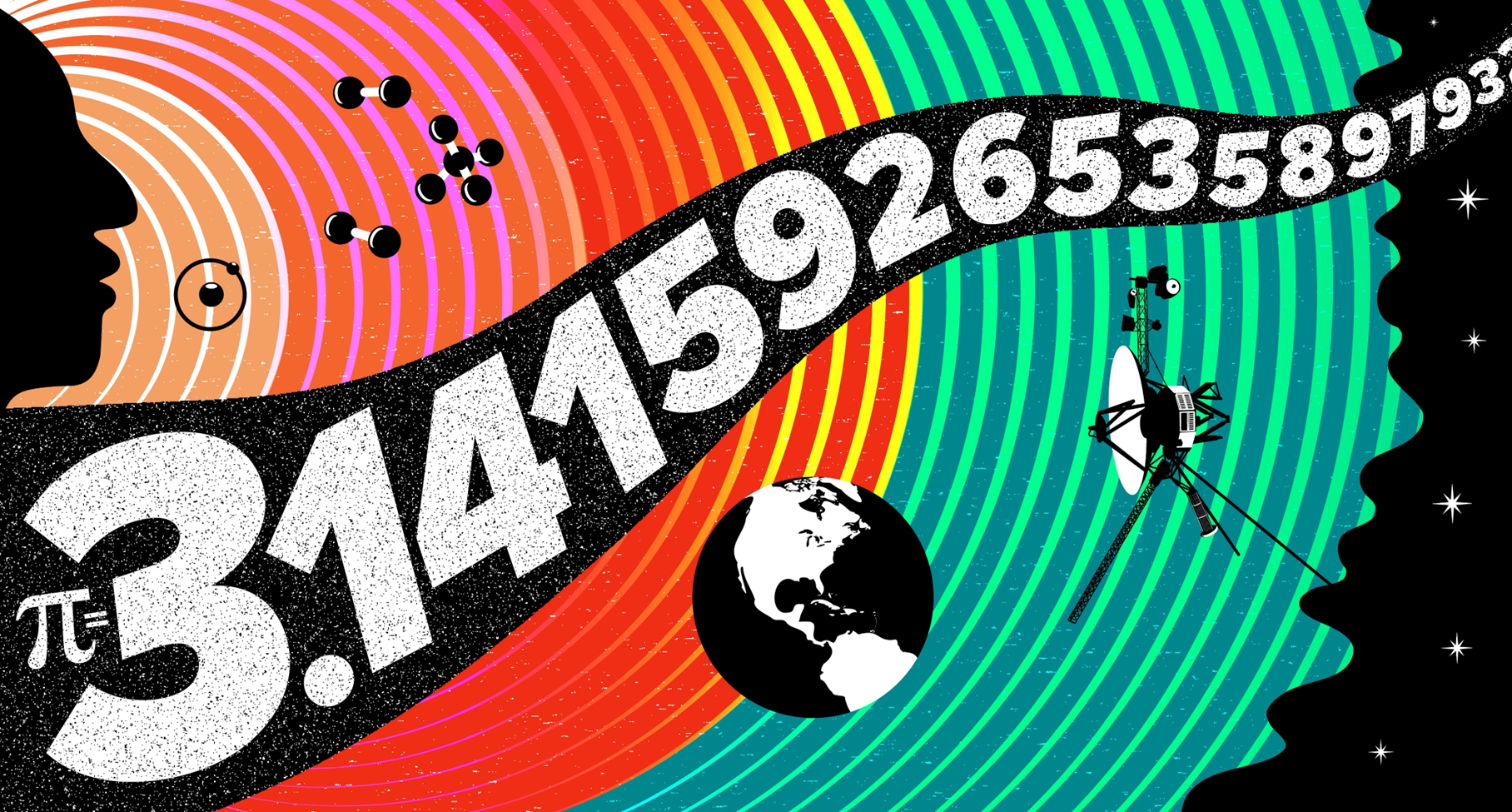
-
NASA uses a value of π = 3.141592653589793 with 15 decimal digits for interplanetary navigation.
Calculating the circumference of the circle with radius = 32 billion km, slightly larger than the distance of the Voyager 1 spacecraft, and π with 15 digits, gives an error of just 1.5 cm.
Calculating the circumference of the Universe with radius = 46 billion light years, with an accuracy equal to the diameter of a hydrogen atom, requires 37 decimal digits.
https://www.jpl.nasa.gov/edu/news/how-many-decimals-of-pi-do-we-really-need/
#PiDay
2/n@AkaSci The universe has a circumference?

-
NASA uses a value of π = 3.141592653589793 with 15 decimal digits for interplanetary navigation.
Calculating the circumference of the circle with radius = 32 billion km, slightly larger than the distance of the Voyager 1 spacecraft, and π with 15 digits, gives an error of just 1.5 cm.
Calculating the circumference of the Universe with radius = 46 billion light years, with an accuracy equal to the diameter of a hydrogen atom, requires 37 decimal digits.
https://www.jpl.nasa.gov/edu/news/how-many-decimals-of-pi-do-we-really-need/
#PiDay
2/nThis remarkable equation for π by Indian mathematician Srinivasa Ramanujan, developed around 1910-1914, is an infinite series with some curious numbers and an interesting property. The first k terms of the sum give π with ~8*k decimal digits.
E.g., the 1st term gives π = 3.141592 73001..., which is accurate to 6 decimal places.
Using 2 terms, we get π = 3.141592 653589793 87808..., which is accurate to 15 decimal places.
https://www.piday.org/million/
#PiDay2026 #PiDay
3/n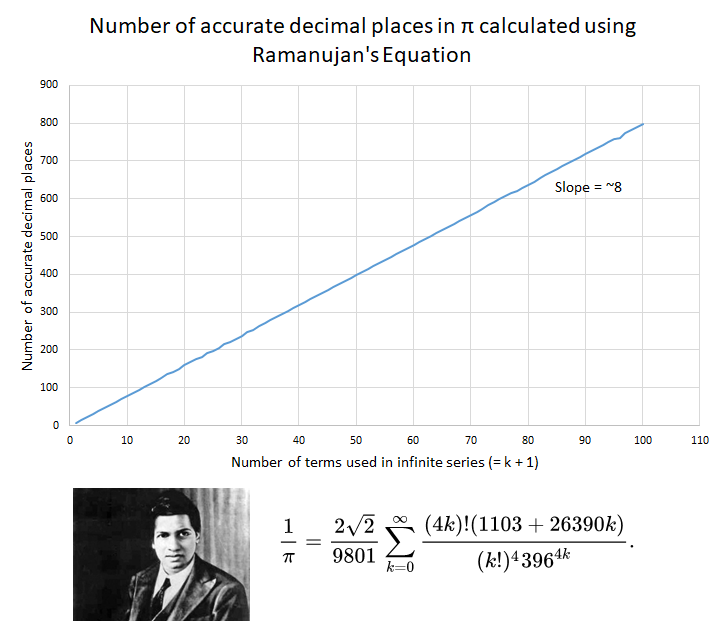
-
This remarkable equation for π by Indian mathematician Srinivasa Ramanujan, developed around 1910-1914, is an infinite series with some curious numbers and an interesting property. The first k terms of the sum give π with ~8*k decimal digits.
E.g., the 1st term gives π = 3.141592 73001..., which is accurate to 6 decimal places.
Using 2 terms, we get π = 3.141592 653589793 87808..., which is accurate to 15 decimal places.
https://www.piday.org/million/
#PiDay2026 #PiDay
3/nOver 75 years after Ramanujan developed the equation for π, the Chudnovsky brothers published this formula, which produces about 14 digits of π per term, more than 2x that of Ramanujan's formula.
There's some sorcery in these numbers.
🪄
https://en.wikipedia.org/wiki/Chudnovsky_brothers
#PiDay2026 #PiDay
4/n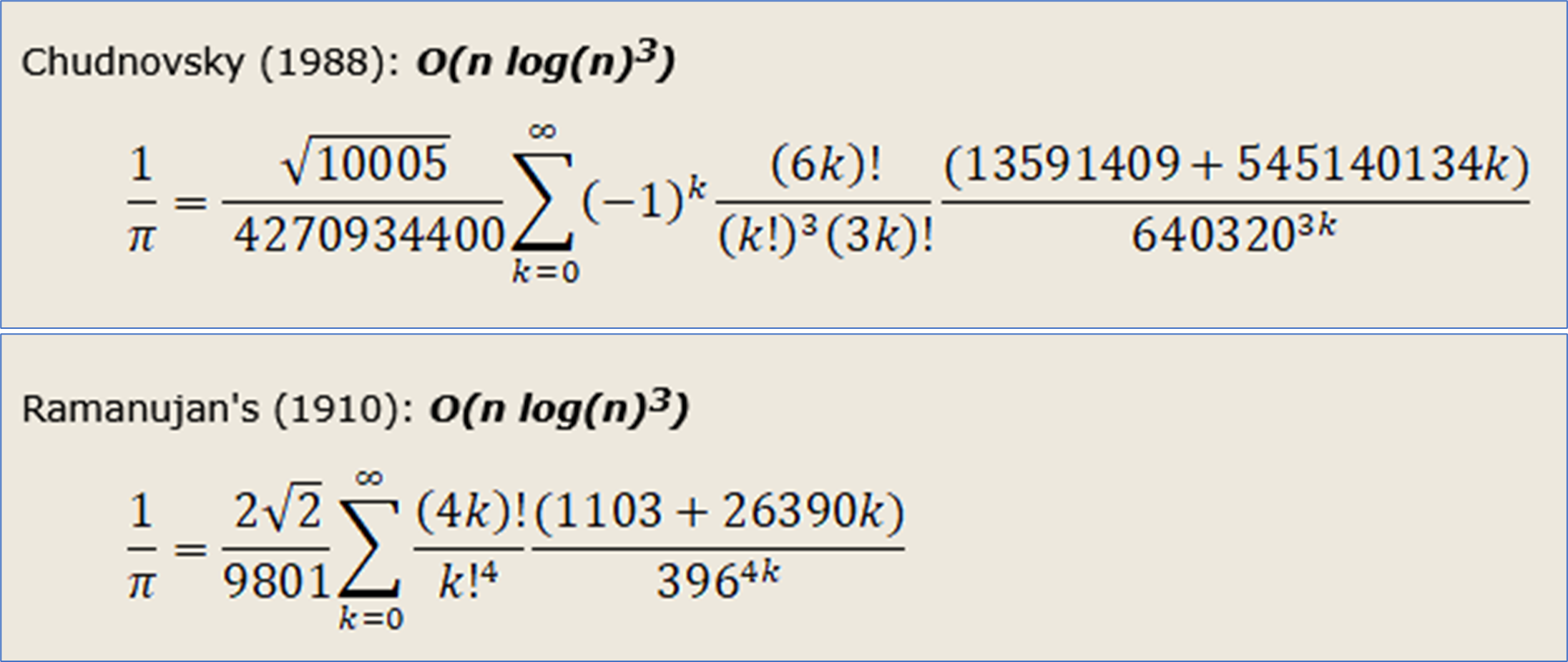
-
Over 75 years after Ramanujan developed the equation for π, the Chudnovsky brothers published this formula, which produces about 14 digits of π per term, more than 2x that of Ramanujan's formula.
There's some sorcery in these numbers.
🪄
https://en.wikipedia.org/wiki/Chudnovsky_brothers
#PiDay2026 #PiDay
4/nThe current record for the number of digits of π stands at 314 trillion, computed in December 2025 by engineers at StorageView Lab.
Hardware: Dell PowerEdge R7725 with dual AMD EPYC 192-Core CPUs
Storage: Forty 61.44TB Micron 6550 Ion SSDs
Software: y-cruncher
Algorithms: Chudnovsky and Ramanujan
Run time: uninterrupted 110 days. That's an avg of over 33 million digits per second.https://www.storagereview.com/review/storagereview-sets-new-pi-record-314-trillion-digits-on-a-dell-poweredge-r7725
https://www.numberworld.org/y-cruncher/
#PiDay2026 #PiDay
5/n -
R relay@relay.mycrowd.ca shared this topic
-
Over 75 years after Ramanujan developed the equation for π, the Chudnovsky brothers published this formula, which produces about 14 digits of π per term, more than 2x that of Ramanujan's formula.
There's some sorcery in these numbers.
🪄
https://en.wikipedia.org/wiki/Chudnovsky_brothers
#PiDay2026 #PiDay
4/n@AkaSci The seventh equation was found in 1995.
https://en.wikipedia.org/wiki/Bailey%E2%80%93Borwein%E2%80%93Plouffe_formula
BTW it occurs twice in your list. If it is in time-of-discovery order, the last one is the proper one.
BTW2 the first equation (Euler?) is just pretty. You cannot compute with it...
-
The current record for the number of digits of π stands at 314 trillion, computed in December 2025 by engineers at StorageView Lab.
Hardware: Dell PowerEdge R7725 with dual AMD EPYC 192-Core CPUs
Storage: Forty 61.44TB Micron 6550 Ion SSDs
Software: y-cruncher
Algorithms: Chudnovsky and Ramanujan
Run time: uninterrupted 110 days. That's an avg of over 33 million digits per second.https://www.storagereview.com/review/storagereview-sets-new-pi-record-314-trillion-digits-on-a-dell-poweredge-r7725
https://www.numberworld.org/y-cruncher/
#PiDay2026 #PiDay
5/n@AkaSci They should have went for 314,159,265,358,979 digits rather than the flat 314 trillion...