Skip to content
  • Categories
  • Recent
  • Tags
  • Popular
  • World
  • Users
  • Groups
Skins
  • Light
  • Brite
  • Cerulean
  • Cosmo
  • Flatly
  • Journal
  • Litera
  • Lumen
  • Lux
  • Materia
  • Minty
  • Morph
  • Pulse
  • Sandstone
  • Simplex
  • Sketchy
  • Spacelab
  • United
  • Yeti
  • Zephyr
  • Dark
  • Cyborg
  • Darkly
  • Quartz
  • Slate
  • Solar
  • Superhero
  • Vapor

  • Default (Cyborg)
  • No Skin
Collapse
Brand Logo

CIRCLE WITH A DOT

  1. Home
  2. Uncategorized
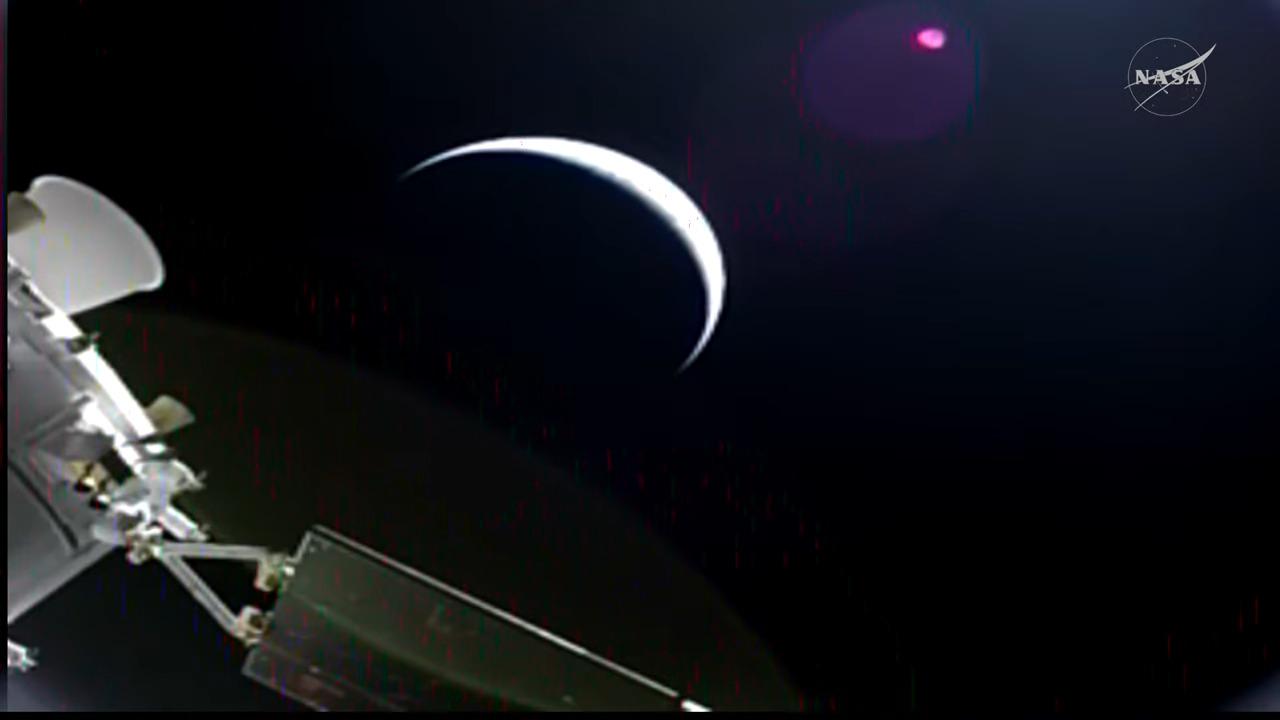
  3. A crescent Earth as seen from the Artemis II Orion Integrity spacecraft, now over 46,000 km away.

A crescent Earth as seen from the Artemis II Orion Integrity spacecraft, now over 46,000 km away.
Scheduled Pinned Locked Moved Uncategorized
74 Posts 29 Posters 0 Views
  • Oldest to Newest
  • Newest to Oldest
  • Most Votes
Reply
  • Reply as topic
Log in to reply
This topic has been deleted. Only users with topic management privileges can see it.
  • akasci@fosstodon.orgA akasci@fosstodon.org

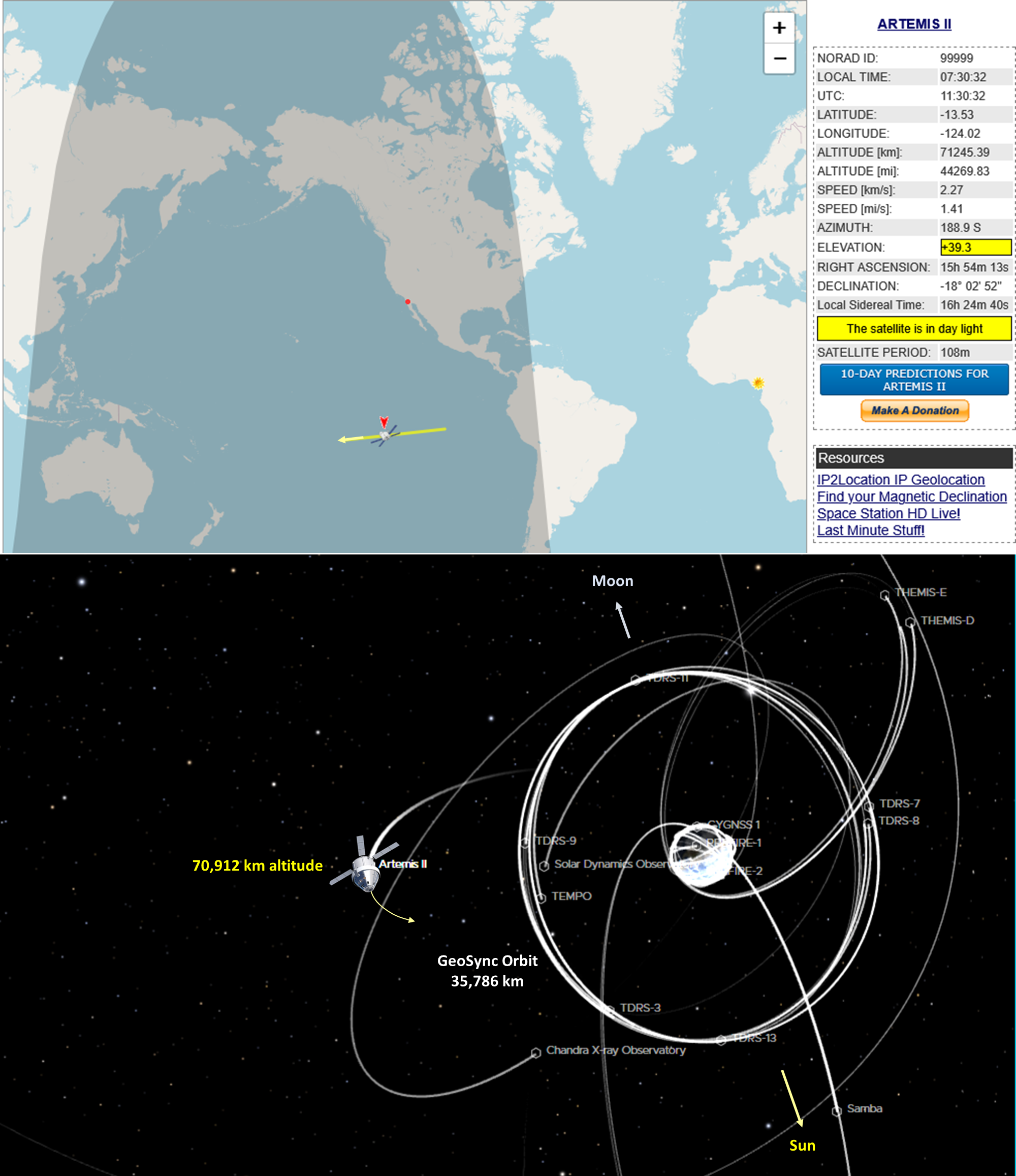
    Integrity, the Artemis II Orion Integrity spacecraft, is located 71,245 km away, almost 2x the alt. of GSO, in a highly elliptical orbit, above the Pacific Ocean, west of Peru.

    After reaching Apogee, it will turn around and execute a Perigee Raising Burn at around 8:15 a.m. EDT (12:15 UTC) and head back towards Earth.

    12 hours later, at Perigee, it will execute the Translunar Injection Burn and shoot for the Moon.

    https://www.n2yo.com/?s=99999&live=1
    https://eyes.nasa.gov/apps/solar-system/#/sc_artemis_2
    https://www.nasa.gov/artemis-ii-press-kit/
    24/n
    Link Preview Image
    photo55@mastodon.socialP This user is from outside of this forum
    photo55@mastodon.socialP This user is from outside of this forum
    photo55@mastodon.social
    wrote last edited by
    #12

    @AkaSci
    #OberthManeuver

    1 Reply Last reply
    0
    • akasci@fosstodon.orgA akasci@fosstodon.org

      Integrity, the Artemis II Orion Integrity spacecraft, is located 71,245 km away, almost 2x the alt. of GSO, in a highly elliptical orbit, above the Pacific Ocean, west of Peru.

      After reaching Apogee, it will turn around and execute a Perigee Raising Burn at around 8:15 a.m. EDT (12:15 UTC) and head back towards Earth.

      12 hours later, at Perigee, it will execute the Translunar Injection Burn and shoot for the Moon.

      https://www.n2yo.com/?s=99999&live=1
      https://eyes.nasa.gov/apps/solar-system/#/sc_artemis_2
      https://www.nasa.gov/artemis-ii-press-kit/
      24/n

      Link Preview Image
      P This user is from outside of this forum
      P This user is from outside of this forum
      phosphenes@glasgow.social
      wrote last edited by
      #13

      @AkaSci

      It amazes me what a big deal this is and how little people are noticing because of all the other terrible distractions.

      1 Reply Last reply
      0
      • akasci@fosstodon.orgA akasci@fosstodon.org

        Integrity, the Artemis II Orion Integrity spacecraft, is located 71,245 km away, almost 2x the alt. of GSO, in a highly elliptical orbit, above the Pacific Ocean, west of Peru.

        After reaching Apogee, it will turn around and execute a Perigee Raising Burn at around 8:15 a.m. EDT (12:15 UTC) and head back towards Earth.

        12 hours later, at Perigee, it will execute the Translunar Injection Burn and shoot for the Moon.

        https://www.n2yo.com/?s=99999&live=1
        https://eyes.nasa.gov/apps/solar-system/#/sc_artemis_2
        https://www.nasa.gov/artemis-ii-press-kit/
        24/n

        Link Preview Image
        akasci@fosstodon.orgA This user is from outside of this forum
        akasci@fosstodon.orgA This user is from outside of this forum
        akasci@fosstodon.org
        wrote last edited by
        #14

        Artemis II astronauts woke up this morning at 7:06 a.m. EDT with the song “Sleepyhead” by Young and Sick.

        They then completed the perigee raise burn by igniting the Orion service module’s main engine for 43 seconds, which modified the trajectory to a 191x70133 km elliptical orbit. Perigee in another 12 hours or so.

        The crew members will rest for another 4.5 hours before they are again awakened to start their first full day in space.

        https://www.youtube.com/watch?v=hIW-w-P2nOc
        https://www.nasa.gov/blogs/missions/2026/04/02/artemis-ii-flight-update-perigee-raise-burn-complete/
        25/n

        akasci@fosstodon.orgA 1 Reply Last reply
        0
        • akasci@fosstodon.orgA akasci@fosstodon.org

          Artemis II astronauts woke up this morning at 7:06 a.m. EDT with the song “Sleepyhead” by Young and Sick.

          They then completed the perigee raise burn by igniting the Orion service module’s main engine for 43 seconds, which modified the trajectory to a 191x70133 km elliptical orbit. Perigee in another 12 hours or so.

          The crew members will rest for another 4.5 hours before they are again awakened to start their first full day in space.

          https://www.youtube.com/watch?v=hIW-w-P2nOc
          https://www.nasa.gov/blogs/missions/2026/04/02/artemis-ii-flight-update-perigee-raise-burn-complete/
          25/n

          akasci@fosstodon.orgA This user is from outside of this forum
          akasci@fosstodon.orgA This user is from outside of this forum
          akasci@fosstodon.org
          wrote last edited by
          #15

          Artemis II has a total of 28 camera systems, many for internal and external inspection and navigation, 4 located on each of Orion’s 4 solar arrays.

          The fixed engineering cameras are primarily meant for in-flight inspection of the spacecraft. But they also opportunistically capture images of Earth and the moon in the background.

          The astronauts carry two handheld Nikon D5 digital SLR 20.8 MP cameras for hi-res images and videos.

          https://talkoftitusville.com/2025/12/24/what-cameras-will-the-artemis-ii-astronauts-have-aboard/
          https://ntrs.nasa.gov/api/citations/20230017638/downloads/1325_Melendrez_Orion%20Imaging%20Capabilities.pdf
          26/n

          ottaross@mastodon.socialO akasci@fosstodon.orgA michaelgemar@cosocial.caM wcbdata@vis.socialW 4 Replies Last reply
          0
          • akasci@fosstodon.orgA akasci@fosstodon.org

            Artemis II has a total of 28 camera systems, many for internal and external inspection and navigation, 4 located on each of Orion’s 4 solar arrays.

            The fixed engineering cameras are primarily meant for in-flight inspection of the spacecraft. But they also opportunistically capture images of Earth and the moon in the background.

            The astronauts carry two handheld Nikon D5 digital SLR 20.8 MP cameras for hi-res images and videos.

            https://talkoftitusville.com/2025/12/24/what-cameras-will-the-artemis-ii-astronauts-have-aboard/
            https://ntrs.nasa.gov/api/citations/20230017638/downloads/1325_Melendrez_Orion%20Imaging%20Capabilities.pdf
            26/n

            ottaross@mastodon.socialO This user is from outside of this forum
            ottaross@mastodon.socialO This user is from outside of this forum
            ottaross@mastodon.social
            wrote last edited by
            #16

            @AkaSci Nice graphic! I haven't found anywhere that is continuously streaming imagery from any of those.

            Any links/ideas?

            Edit: Oh there is a feed at:
            https://www.nasa.gov/live/

            akasci@fosstodon.orgA 1 Reply Last reply
            0
            • ottaross@mastodon.socialO ottaross@mastodon.social

              @AkaSci Nice graphic! I haven't found anywhere that is continuously streaming imagery from any of those.

              Any links/ideas?

              Edit: Oh there is a feed at:
              https://www.nasa.gov/live/

              akasci@fosstodon.orgA This user is from outside of this forum
              akasci@fosstodon.orgA This user is from outside of this forum
              akasci@fosstodon.org
              wrote last edited by
              #17

              @ottaross
              This NASA YouTube site has continuous coverage of the Artemis II mission. Tends to show video from one of the solar array cameras, but breaks up occasionally.
              https://www.youtube.com/watch?v=6RwfNBtepa4

              ottaross@mastodon.socialO 1 Reply Last reply
              0
              • akasci@fosstodon.orgA akasci@fosstodon.org

                @ottaross
                This NASA YouTube site has continuous coverage of the Artemis II mission. Tends to show video from one of the solar array cameras, but breaks up occasionally.
                https://www.youtube.com/watch?v=6RwfNBtepa4

                ottaross@mastodon.socialO This user is from outside of this forum
                ottaross@mastodon.socialO This user is from outside of this forum
                ottaross@mastodon.social
                wrote last edited by
                #18

                @AkaSci I think I've just nabbed the same feed from NASA.gov/live.

                Yeah I see what you mean about the break-ups. Nice to ride along though!

                1 Reply Last reply
                0
                • akasci@fosstodon.orgA akasci@fosstodon.org

                  Artemis II has a total of 28 camera systems, many for internal and external inspection and navigation, 4 located on each of Orion’s 4 solar arrays.

                  The fixed engineering cameras are primarily meant for in-flight inspection of the spacecraft. But they also opportunistically capture images of Earth and the moon in the background.

                  The astronauts carry two handheld Nikon D5 digital SLR 20.8 MP cameras for hi-res images and videos.

                  https://talkoftitusville.com/2025/12/24/what-cameras-will-the-artemis-ii-astronauts-have-aboard/
                  https://ntrs.nasa.gov/api/citations/20230017638/downloads/1325_Melendrez_Orion%20Imaging%20Capabilities.pdf
                  26/n

                  akasci@fosstodon.orgA This user is from outside of this forum
                  akasci@fosstodon.orgA This user is from outside of this forum
                  akasci@fosstodon.org
                  wrote last edited by
                  #19

                  Check out this dashboard for real-time status and telemetry from Artemis II.

                  Link Preview Image
                  Artemis II Tracker — Live Mission Control

                  Real-time mission control dashboard tracking NASA's Artemis II crewed lunar flyby. Live telemetry, DSN comms, orbit visualization, and crew activities.

                  favicon

                  Canadian Space (artemis.cdnspace.ca)

                  h/t @cdnspace
                  https://fosstodon.org/@cdnspace@mstdn.ca/116336006900298832
                  27/n

                  zenheathen@beige.partyZ akasci@fosstodon.orgA 2 Replies Last reply
                  0
                  • akasci@fosstodon.orgA akasci@fosstodon.org

                    Check out this dashboard for real-time status and telemetry from Artemis II.

                    Link Preview Image
                    Artemis II Tracker — Live Mission Control

                    Real-time mission control dashboard tracking NASA's Artemis II crewed lunar flyby. Live telemetry, DSN comms, orbit visualization, and crew activities.

                    favicon

                    Canadian Space (artemis.cdnspace.ca)

                    h/t @cdnspace
                    https://fosstodon.org/@cdnspace@mstdn.ca/116336006900298832
                    27/n

                    zenheathen@beige.partyZ This user is from outside of this forum
                    zenheathen@beige.partyZ This user is from outside of this forum
                    zenheathen@beige.party
                    wrote last edited by
                    #20

                    @AkaSci @cdnspace This is the best tracker site for the mission I've seen anywhere. Good job, CSA!

                    1 Reply Last reply
                    0
                    • akasci@fosstodon.orgA akasci@fosstodon.org

                      Artemis II has a total of 28 camera systems, many for internal and external inspection and navigation, 4 located on each of Orion’s 4 solar arrays.

                      The fixed engineering cameras are primarily meant for in-flight inspection of the spacecraft. But they also opportunistically capture images of Earth and the moon in the background.

                      The astronauts carry two handheld Nikon D5 digital SLR 20.8 MP cameras for hi-res images and videos.

                      https://talkoftitusville.com/2025/12/24/what-cameras-will-the-artemis-ii-astronauts-have-aboard/
                      https://ntrs.nasa.gov/api/citations/20230017638/downloads/1325_Melendrez_Orion%20Imaging%20Capabilities.pdf
                      26/n

                      michaelgemar@cosocial.caM This user is from outside of this forum
                      michaelgemar@cosocial.caM This user is from outside of this forum
                      michaelgemar@cosocial.ca
                      wrote last edited by
                      #21

                      @AkaSci I don’t understand how NASA can spend billions on their flagship mission and not have better camera feeds. Why not put a Starlink on Orion? This is their biggest PR event, and we were stuck mainly with renders during launch.

                      akasci@fosstodon.orgA 2 Replies Last reply
                      0
                      • michaelgemar@cosocial.caM michaelgemar@cosocial.ca

                        @AkaSci I don’t understand how NASA can spend billions on their flagship mission and not have better camera feeds. Why not put a Starlink on Orion? This is their biggest PR event, and we were stuck mainly with renders during launch.

                        akasci@fosstodon.orgA This user is from outside of this forum
                        akasci@fosstodon.orgA This user is from outside of this forum
                        akasci@fosstodon.org
                        wrote last edited by
                        #22

                        @michaelgemar
                        Starlink? Starlink satellites look down at earth, not up or sideways at other spacecraft.

                        Currently, Orion is at ~70,000 km altitude.

                        NASA has continuous telemetry and video from Artemis II using DSN; they just aren't webcasting it, as one would expect.

                        Link Preview Image
                        Deep Space Network Now

                        The real time status of communications with our deep space explorers

                        favicon

                        Deep Space Network Now (eyes.nasa.gov)

                        michaelgemar@cosocial.caM 1 Reply Last reply
                        0
                        • akasci@fosstodon.orgA akasci@fosstodon.org

                          @michaelgemar
                          Starlink? Starlink satellites look down at earth, not up or sideways at other spacecraft.

                          Currently, Orion is at ~70,000 km altitude.

                          NASA has continuous telemetry and video from Artemis II using DSN; they just aren't webcasting it, as one would expect.

                          Link Preview Image
                          Deep Space Network Now

                          The real time status of communications with our deep space explorers

                          favicon

                          Deep Space Network Now (eyes.nasa.gov)

                          michaelgemar@cosocial.caM This user is from outside of this forum
                          michaelgemar@cosocial.caM This user is from outside of this forum
                          michaelgemar@cosocial.ca
                          wrote last edited by
                          #23

                          @AkaSci Fair point. They would have certainly helped at launch, but aren’t much use now.

                          1 Reply Last reply
                          0
                          • michaelgemar@cosocial.caM michaelgemar@cosocial.ca

                            @AkaSci I don’t understand how NASA can spend billions on their flagship mission and not have better camera feeds. Why not put a Starlink on Orion? This is their biggest PR event, and we were stuck mainly with renders during launch.

                            akasci@fosstodon.orgA This user is from outside of this forum
                            akasci@fosstodon.orgA This user is from outside of this forum
                            akasci@fosstodon.org
                            wrote last edited by
                            #24

                            @michaelgemar
                            Artemis II is also carrying an Optical Communication System, which will use lasers to communicate with earth, at very high data rates.

                            I have not read much about, yet. That should bring us some high-res video from the vicinity of the moon.

                            Link Preview Image
                            Exploration and Space Communications: LEMNOS - NASA

                            favicon

                            NASA (www.nasa.gov)

                            1 Reply Last reply
                            0
                            • akasci@fosstodon.orgA akasci@fosstodon.org

                              A crescent Earth as seen from the Artemis II Orion Integrity spacecraft, now over 46,000 km away. The spacecraft is located above the north-east coast of Brazil, where it is night-time

                              22/n

                              oldfartrant@mstdn.caO This user is from outside of this forum
                              oldfartrant@mstdn.caO This user is from outside of this forum
                              oldfartrant@mstdn.ca
                              wrote last edited by
                              #25

                              @AkaSci somehow Trump didn't manage to get his name on it.

                              1 Reply Last reply
                              1
                              0
                              • R relay@relay.mycrowd.ca shared this topic
                              • akasci@fosstodon.orgA akasci@fosstodon.org

                                Check out this dashboard for real-time status and telemetry from Artemis II.

                                Link Preview Image
                                Artemis II Tracker — Live Mission Control

                                Real-time mission control dashboard tracking NASA's Artemis II crewed lunar flyby. Live telemetry, DSN comms, orbit visualization, and crew activities.

                                favicon

                                Canadian Space (artemis.cdnspace.ca)

                                h/t @cdnspace
                                https://fosstodon.org/@cdnspace@mstdn.ca/116336006900298832
                                27/n

                                akasci@fosstodon.orgA This user is from outside of this forum
                                akasci@fosstodon.orgA This user is from outside of this forum
                                akasci@fosstodon.org
                                wrote last edited by
                                #26

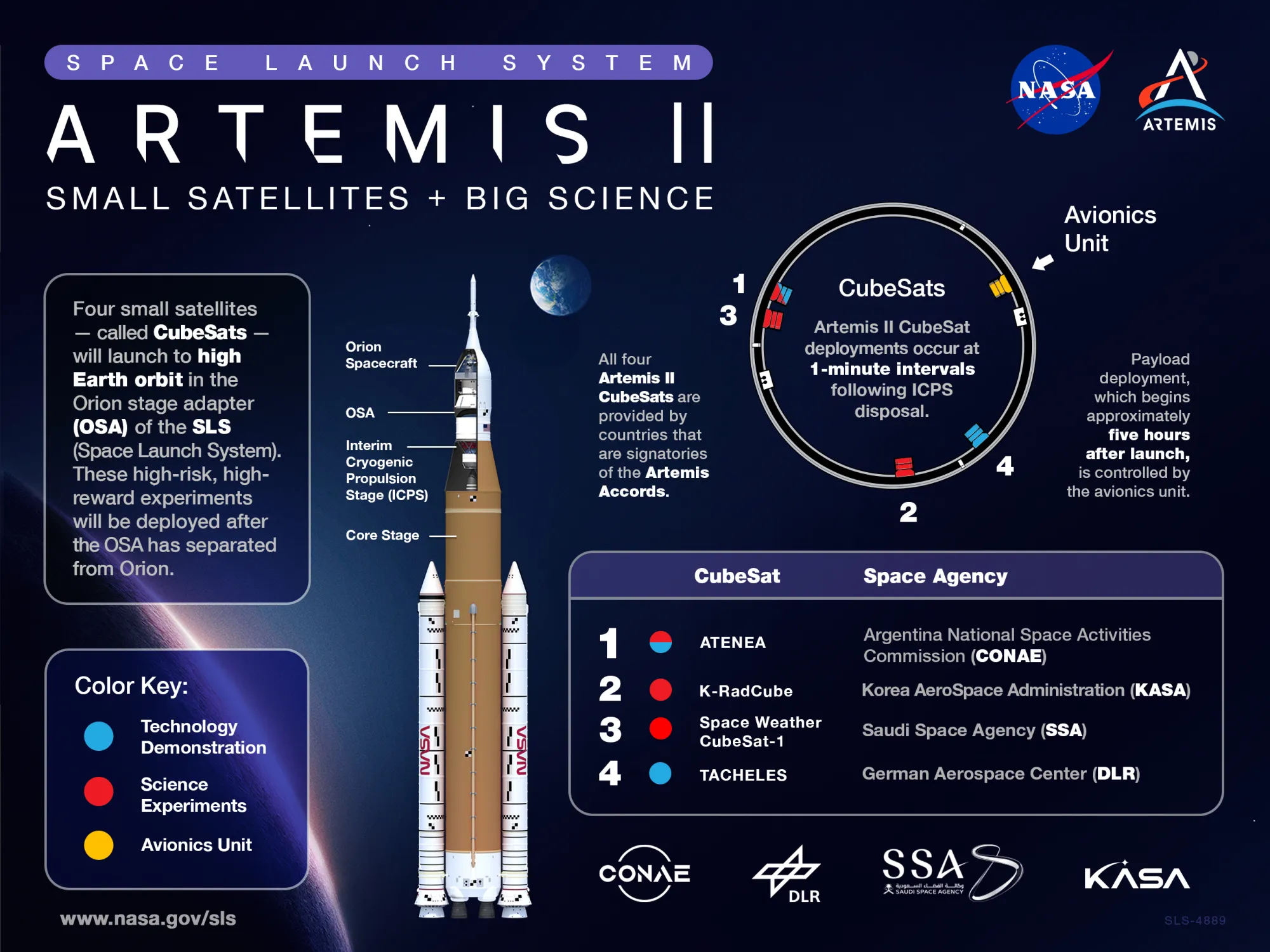
                                Cubesats deployed by Artemis II in High Earth Orbit:

                                TACHELES, German Space Agency: Effects of space env on electrical components.

                                K-RadCube, Korea AeroSpace Admin: Space radiation and its biological effects

                                Space Weather CubeSat-1, Saudi Space Agency: Space weather at a range of distances from Earth

                                ATENEA, Argentina's Space Agency; Assess radiation shielding methods, measure Earth's radiation spectrum, collect GPS data and validate a long-range comm link

                                https://digitalcommons.usu.edu/cgi/viewcontent.cgi?article=6197&context=smallsat
                                28/n
                                Link Preview Image
                                akasci@fosstodon.orgA 1 Reply Last reply
                                0
                                • akasci@fosstodon.orgA akasci@fosstodon.org

                                  Cubesats deployed by Artemis II in High Earth Orbit:

                                  TACHELES, German Space Agency: Effects of space env on electrical components.

                                  K-RadCube, Korea AeroSpace Admin: Space radiation and its biological effects

                                  Space Weather CubeSat-1, Saudi Space Agency: Space weather at a range of distances from Earth

                                  ATENEA, Argentina's Space Agency; Assess radiation shielding methods, measure Earth's radiation spectrum, collect GPS data and validate a long-range comm link

                                  https://digitalcommons.usu.edu/cgi/viewcontent.cgi?article=6197&context=smallsat
                                  28/n

                                  Link Preview Image
                                  akasci@fosstodon.orgA This user is from outside of this forum
                                  akasci@fosstodon.orgA This user is from outside of this forum
                                  akasci@fosstodon.org
                                  wrote last edited by
                                  #27

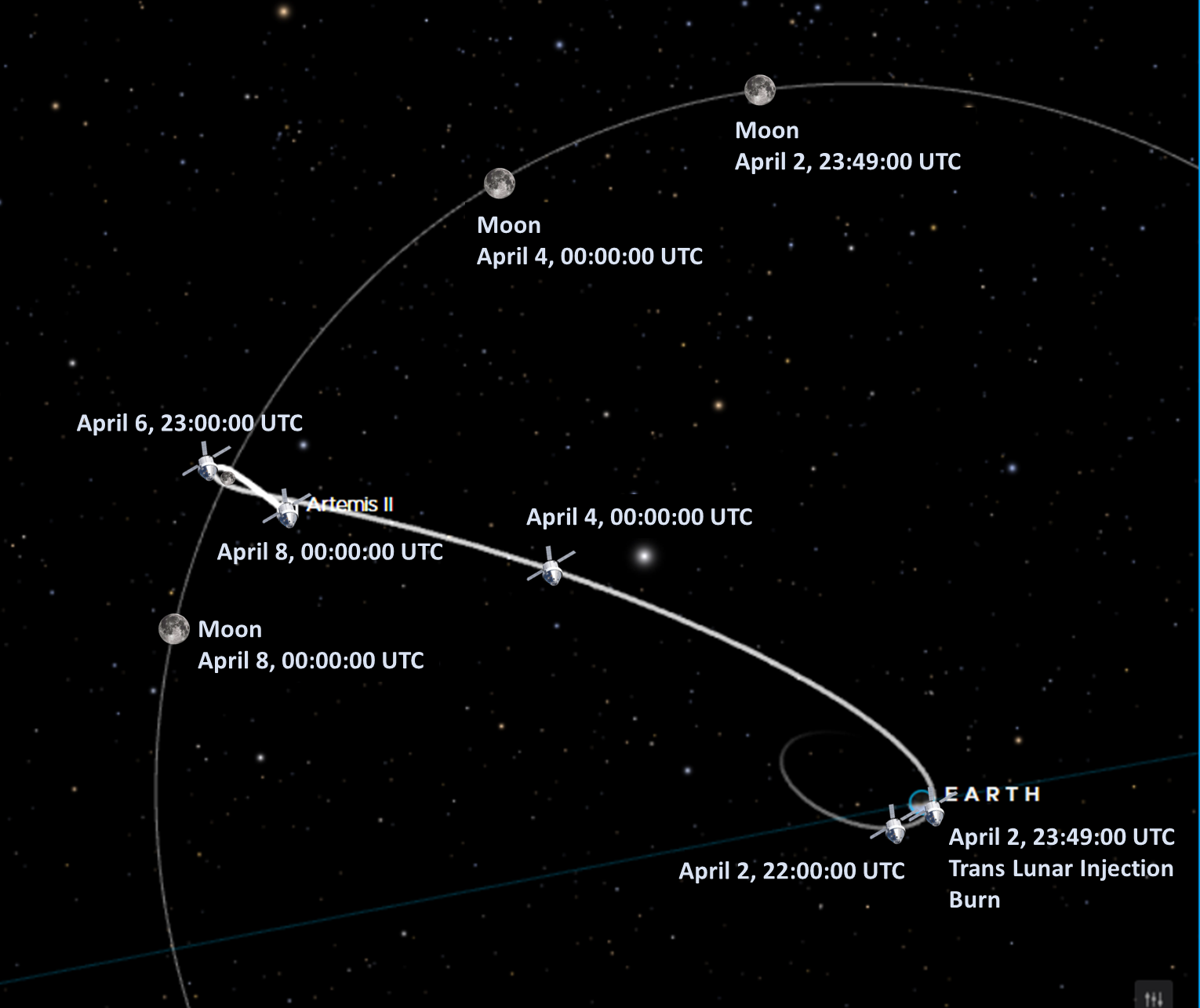
                                  Artemis II Trans Lunar Injection (TLI) burn coming up at 7:49 p.m. EDT.

                                  The 349-second burn will increase Integrity's speed of ~11,000 m/s by 388 m/s and stretch the current 191x70,133 km elliptical orbit to go ~10,427 km beyond the moon and return back to earth.

                                  A few minor burns will be made during the trip to fine-tune the trajectory.

                                  The graphic below shows the approx. location of Integrity and the moon - now, during TLI and around April 6-8.

                                  Go #Artemis2!
                                  https://www.nasa.gov/blogs/missions/2026/04/02/artemis-ii-flight-day-2-crew-houston-poll-go-for-translunar-injection-burn/
                                  29/n

                                  Link Preview Image
                                  akasci@fosstodon.orgA 1 Reply Last reply
                                  1
                                  0
                                  • akasci@fosstodon.orgA akasci@fosstodon.org

                                    Artemis II Trans Lunar Injection (TLI) burn coming up at 7:49 p.m. EDT.

                                    The 349-second burn will increase Integrity's speed of ~11,000 m/s by 388 m/s and stretch the current 191x70,133 km elliptical orbit to go ~10,427 km beyond the moon and return back to earth.

                                    A few minor burns will be made during the trip to fine-tune the trajectory.

                                    The graphic below shows the approx. location of Integrity and the moon - now, during TLI and around April 6-8.

                                    Go #Artemis2!

                                    https://www.nasa.gov/blogs/missions/2026/04/02/artemis-ii-flight-day-2-crew-houston-poll-go-for-translunar-injection-burn/
                                    29/n

                                    Link Preview Image
                                    akasci@fosstodon.orgA This user is from outside of this forum
                                    akasci@fosstodon.orgA This user is from outside of this forum
                                    akasci@fosstodon.org
                                    wrote last edited by
                                    #28

                                    One might consider it foolhardy for Artemis II Orion to come screaming down at 11 km/s to 191 km altitude, cross the paths of the LEO constellations and debris around 500 km, perform the TLI to adjust its speed and trajectory and race away, without colliding with anything.

                                    But we can be assured that all that is taken care of and LEO satellites will maneuver to get out of the way as needed.
                                    😱🤞
                                    https://satellitetracker3d.com/track?norad-id=27426
                                    30/n

                                    akasci@fosstodon.orgA f4grx@chaos.socialF daniel_pagenstecher@mastodon.socialD hittitezombie@mastodon.me.ukH 4 Replies Last reply
                                    0
                                    • akasci@fosstodon.orgA akasci@fosstodon.org

                                      One might consider it foolhardy for Artemis II Orion to come screaming down at 11 km/s to 191 km altitude, cross the paths of the LEO constellations and debris around 500 km, perform the TLI to adjust its speed and trajectory and race away, without colliding with anything.

                                      But we can be assured that all that is taken care of and LEO satellites will maneuver to get out of the way as needed.
                                      😱🤞
                                      https://satellitetracker3d.com/track?norad-id=27426
                                      30/n

                                      akasci@fosstodon.orgA This user is from outside of this forum
                                      akasci@fosstodon.orgA This user is from outside of this forum
                                      akasci@fosstodon.org
                                      wrote last edited by
                                      #29

                                      Artemis II TLI complete. All systems good.

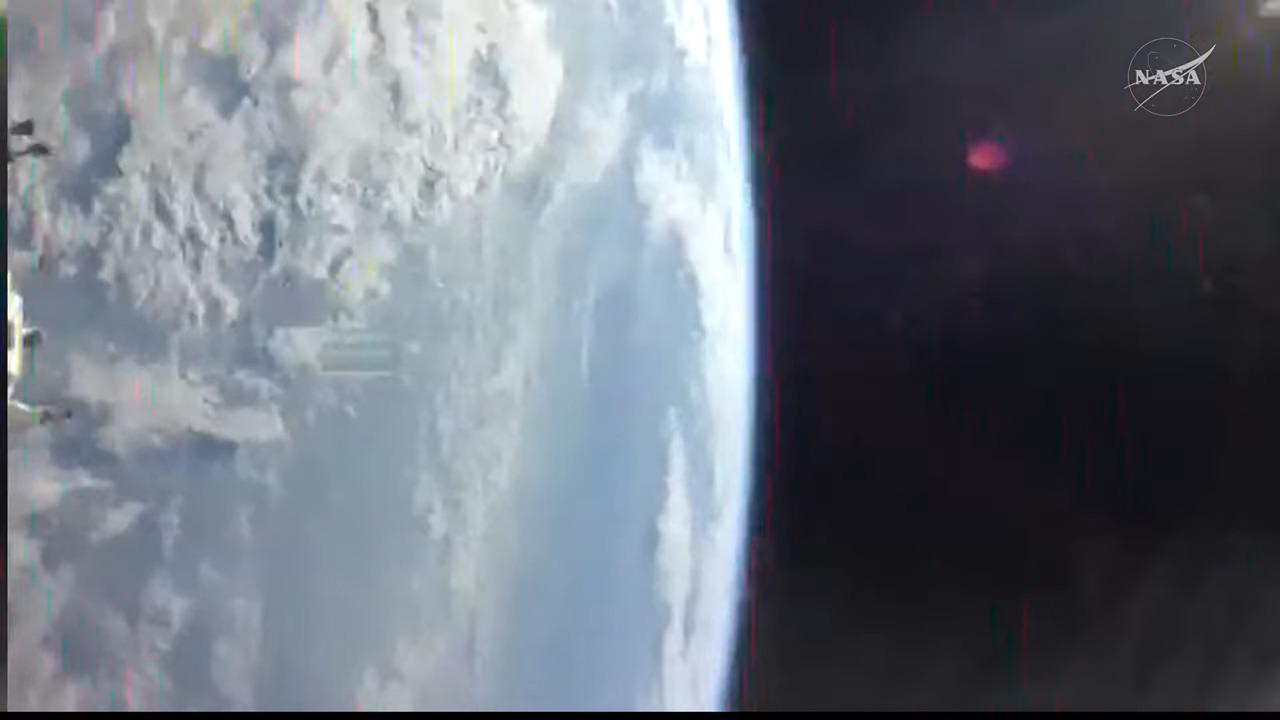
                                      Here is a view of Earth from the spacecraft at altitude ~200 km during the TLI.

                                      Integrity and the 4 astronauts are now headed for the moon.

                                      Current orbit is 202x501,181 km, but the actual values will be slightly smaller due to gravitational interaction with the moon.


                                      31/n
                                      Link Preview Image
                                      akasci@fosstodon.orgA tinydoctor@mstdn.socialT 2 Replies Last reply
                                      1
                                      0
                                      • R relay@relay.infosec.exchange shared this topic
                                      • akasci@fosstodon.orgA akasci@fosstodon.org

                                        One might consider it foolhardy for Artemis II Orion to come screaming down at 11 km/s to 191 km altitude, cross the paths of the LEO constellations and debris around 500 km, perform the TLI to adjust its speed and trajectory and race away, without colliding with anything.

                                        But we can be assured that all that is taken care of and LEO satellites will maneuver to get out of the way as needed.
                                        😱🤞
                                        https://satellitetracker3d.com/track?norad-id=27426
                                        30/n

                                        f4grx@chaos.socialF This user is from outside of this forum
                                        f4grx@chaos.socialF This user is from outside of this forum
                                        f4grx@chaos.social
                                        wrote last edited by
                                        #30

                                        @AkaSci holy crap

                                        1 Reply Last reply
                                        0
                                        • akasci@fosstodon.orgA akasci@fosstodon.org

                                          Artemis II TLI complete. All systems good.

                                          Here is a view of Earth from the spacecraft at altitude ~200 km during the TLI.

                                          Integrity and the 4 astronauts are now headed for the moon.

                                          Current orbit is 202x501,181 km, but the actual values will be slightly smaller due to gravitational interaction with the moon.


                                          31/n

                                          Link Preview Image
                                          akasci@fosstodon.orgA This user is from outside of this forum
                                          akasci@fosstodon.orgA This user is from outside of this forum
                                          akasci@fosstodon.org
                                          wrote last edited by
                                          #31

                                          It's lonely out there 😞

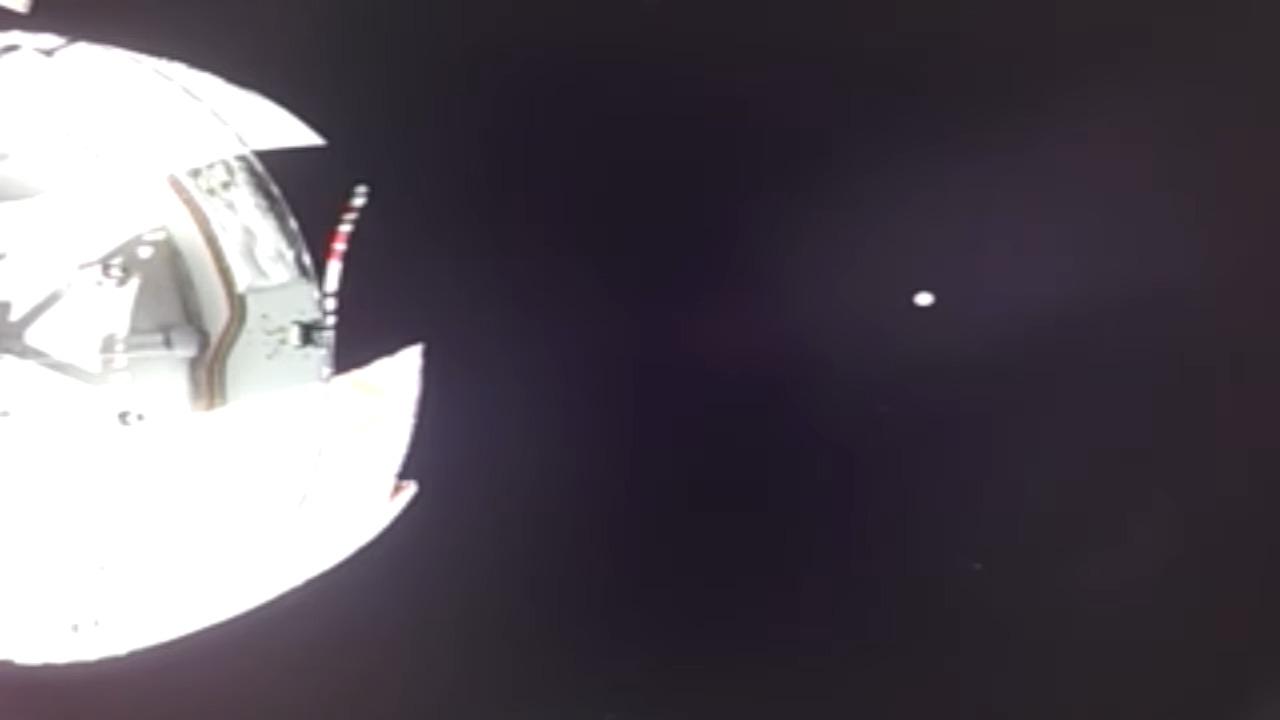
                                          Artemis II Orion is now 33,668 km away, traveling at 15,347 km/h, approaching geo-sync orbit, as Earth gets smaller and smaller in the dark distance.

                                          Astronauts have plenty of work and activities to keep them busy during the mission.

                                          https://www.youtube.com/watch?v=6RwfNBtepa4
                                          32/n
                                          Link Preview Image
                                          akasci@fosstodon.orgA cosmos4u@scicomm.xyzC 2 Replies Last reply
                                          1
                                          0
                                          Reply
                                          • Reply as topic
                                          Log in to reply
                                          • Oldest to Newest
                                          • Newest to Oldest
                                          • Most Votes


                                          • Login

                                          • Login or register to search.
                                          • First post
                                            Last post
                                          0
                                          • Categories
                                          • Recent
                                          • Tags
                                          • Popular
                                          • World
                                          • Users
                                          • Groups