Category error!
-
@olivia @abucci @Iris How do I put this? I find the "category error" criticism accurate. And it rightly prepares and leads into the socioeconomic criticism of dehumanisation of work and into the sociopsychological deskilling criticism.
What I wonder is: is there any "progress" or "benefit", say, of/for the discipline of mathematics once a certain proof exists (assuming the rest of the discipline manages to continue evolving without deskilling) that we risk blinding ourselves to by just insisting that AI isn't itself "proving" things? This focus on the category error makes it sound like if we managed to avoid anthropomorphisation and use different vocabulary for the function AI plays, the criticism would miss the point.
1/2
While writing this, it occurs to me that it's naïve to assume what is in brackets above: that the disipline can evolve in an "untainted" way while accepting on a regular basis proofs that have not been conceived by human scholars. But what kind of taint is that? - I have a hunch it's none of the problems mentioned before. Or is it?
I'll re-read your nice paper on "human-centered AI" and think about how its analyses apply to maths as a discipline.
2/2
-
Category error! I'm sick to the back teeth of wrongheaded comparisons of inanimate objects to humans. It's so rife even colleagues do it. What's next?
> I compared a rock and a person, and challenged them to stay still the longest and the rock won! Wow!
Things thought up by the unhinged & those who wish to dehumanise for profit.
Gift Articles (@GiftArticles@tomkahe.com)
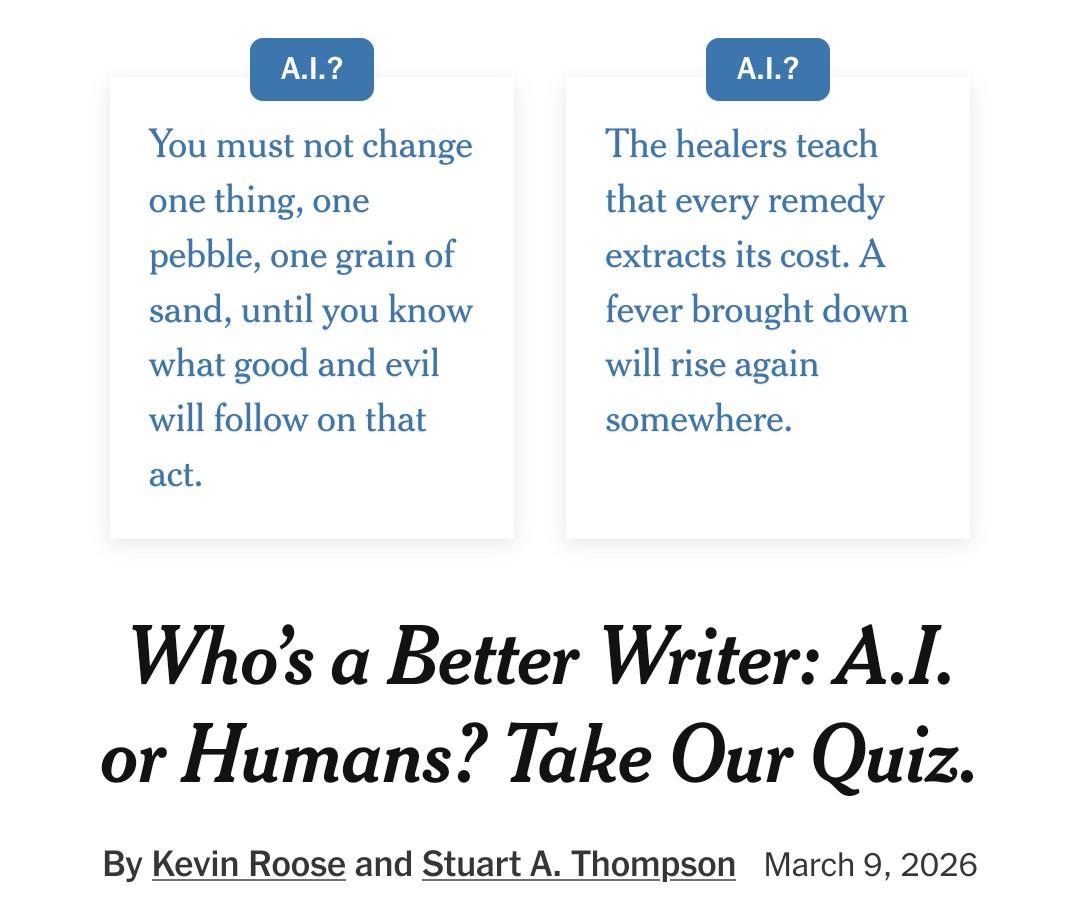
Who’s a Better Writer: A.I. or Humans? Take Our Quiz. (Gift Article) https://www.nytimes.com/interactive/2026/03/09/business/ai-writing-quiz.html?unlocked_article_code=1.R1A.VoOi.CqmTPKAuPwGv&smid=bs-share

Tomkahe (tomkahe.com)
@olivia It makes me especially sick that it happens in times, when we should discuss the legal #personhood of #nature: https://en.wikipedia.org/wiki/Environmental_personhood and listen much more to ideas and thoughts of indigenous people about nature (including pebbles and rocks).
This is becoming increasingly important for survival. Instead, we grant empty algorithms more #life than living #ecosystems! -
@olivia @abucci @Iris How do I put this? I find the "category error" criticism accurate. And it rightly prepares and leads into the socioeconomic criticism of dehumanisation of work and into the sociopsychological deskilling criticism.
What I wonder is: is there any "progress" or "benefit", say, of/for the discipline of mathematics once a certain proof exists (assuming the rest of the discipline manages to continue evolving without deskilling) that we risk blinding ourselves to by just insisting that AI isn't itself "proving" things? This focus on the category error makes it sound like if we managed to avoid anthropomorphisation and use different vocabulary for the function AI plays, the criticism would miss the point.
1/2
@anwagnerdreas@hcommons.social Hi Andreas, there are lots of ways to consider this question:is there any "progress" or "benefit"...that we risk blinding ourselves to by just insisting that AI isn't itself "proving" things?
but the first one that springs to my mind is this. Isn't the more interesting, and pertinent, question "is there any progress or benefit that we risk blinding ourselves to by NOT insisting AI isn't proving things"? Your version of the question takes a default optimistic stance that the use of AI is not harmful or obfuscating to human mathematical thought and practice, when we cannot know one way or the other at this stage. I note that this stance is heavily pushed by the US tech sector, and is therefore already worthy of skepticism. Besides that, mathematics has been around for thousands of years; what justifies enthusiasm for such a radical change to our way of practicing it? Aren't we meant to be conservative about our knowledge production systems? I find discussion of these sorts of questions largely absent in the discourse about AI, at least the mainstream discourse, but shouldn't they be central, given what's at stake? We risk doing the equivalent of throwing away our financial security betting on a slot machine because we won once or twice and the guy next to us claims he made a fortune that way.
@olivia@scholar.social @Iris@scholar.social
-
@anwagnerdreas@hcommons.social Hi Andreas, there are lots of ways to consider this question:
is there any "progress" or "benefit"...that we risk blinding ourselves to by just insisting that AI isn't itself "proving" things?
but the first one that springs to my mind is this. Isn't the more interesting, and pertinent, question "is there any progress or benefit that we risk blinding ourselves to by NOT insisting AI isn't proving things"? Your version of the question takes a default optimistic stance that the use of AI is not harmful or obfuscating to human mathematical thought and practice, when we cannot know one way or the other at this stage. I note that this stance is heavily pushed by the US tech sector, and is therefore already worthy of skepticism. Besides that, mathematics has been around for thousands of years; what justifies enthusiasm for such a radical change to our way of practicing it? Aren't we meant to be conservative about our knowledge production systems? I find discussion of these sorts of questions largely absent in the discourse about AI, at least the mainstream discourse, but shouldn't they be central, given what's at stake? We risk doing the equivalent of throwing away our financial security betting on a slot machine because we won once or twice and the guy next to us claims he made a fortune that way.
@olivia@scholar.social @Iris@scholar.socialHi Anthony, thanks for your response.
The scenario I had in mind was mathematicians of the 2070s still being pretty much like our mathematicians today and those of the past, and looking at the corpus of problems, theorems and proofs established until then, and not caring much about when and in which way a specific proof was introduced. As long as the proof itself is correct as evaluated by those mathematicians themselves. Proving and correctness may lie in the eyes of the human observer, not in the neural network that has outputted the proof. But that does not detract from said correctness at all. I feel uneasy if we focus mainly on how we call this "outputting" or deny that there is a new proof there.
I have already ack'd in the other toot: the scenario is naïve insofar as it assumes the only thing to have changed would be a handful of additional proofs with a different genesis. I'd like to understand the other changes we should expect for the discipline.
-
Hi Anthony, thanks for your response.
The scenario I had in mind was mathematicians of the 2070s still being pretty much like our mathematicians today and those of the past, and looking at the corpus of problems, theorems and proofs established until then, and not caring much about when and in which way a specific proof was introduced. As long as the proof itself is correct as evaluated by those mathematicians themselves. Proving and correctness may lie in the eyes of the human observer, not in the neural network that has outputted the proof. But that does not detract from said correctness at all. I feel uneasy if we focus mainly on how we call this "outputting" or deny that there is a new proof there.
I have already ack'd in the other toot: the scenario is naïve insofar as it assumes the only thing to have changed would be a handful of additional proofs with a different genesis. I'd like to understand the other changes we should expect for the discipline.
@anwagnerdreas @abucci @olivia @Iris
I see it as twofold: a burden of proof argument, and a question about where energies are best spent. For the former, whenever proposing a new tool, the onus is on the person advancing said new proposal to show that it works, or at least works well enough to be worth consideration.
For the second, cranks *could* be right about their wild mathematical claims, but we rightly often reject them out of hand as a timesaving heuristic.
-
@anwagnerdreas @abucci @olivia @Iris
I see it as twofold: a burden of proof argument, and a question about where energies are best spent. For the former, whenever proposing a new tool, the onus is on the person advancing said new proposal to show that it works, or at least works well enough to be worth consideration.
For the second, cranks *could* be right about their wild mathematical claims, but we rightly often reject them out of hand as a timesaving heuristic.
@anwagnerdreas @abucci @olivia @Iris It's impractical to individually evaluate the claims of every crank theorem, and so we largely don't do it.
When it comes to LLM-generated "proofs," I think it's worth comparing to Lean and other formalized proof systems. We rationally have enough confidence in how Lean builds proofs from lower-level theorems and axioms that it's worth approaching Lean-based proofs in good faith. LLMs, by contrast, do not offer any such structure we can use.
-
@anwagnerdreas @abucci @olivia @Iris It's impractical to individually evaluate the claims of every crank theorem, and so we largely don't do it.
When it comes to LLM-generated "proofs," I think it's worth comparing to Lean and other formalized proof systems. We rationally have enough confidence in how Lean builds proofs from lower-level theorems and axioms that it's worth approaching Lean-based proofs in good faith. LLMs, by contrast, do not offer any such structure we can use.
@xgranade@wandering.shop You make several great points.
The non-surveyability issue is a big one: https://en.wikipedia.org/wiki/Non-surveyable_proof . A bunch of people rejected the computer-assisted proof of the four-color theorem until it was significantly simplified. Imagine a math LLM spitting out considerably more complicated proofs at a breakneck pace. I argue that eventually such a thing would be indistinguishable from a random string generator. It'd also waste the time and energy of a whole lot of mathematicians in the process, as you pointed out.
We are already seeing code review---human beings checking pull requests etc---being overwhelmed by LLM code generators. Some organizations are abandoning this step as a result. What purpose is served by introducing this kind of dynamics into mathematics, of all things? It's quite strange to me, this bias towards always accelerating everything whenever that's possible to do, regardless of systemic or other risks.
Proofs written in Lean and similar systems have the very big benefit of surveyability, and there's probably a world in which ethically made and constituted LLMs could add beneficial features to such tools.
The analogy to cranks is interesting. I guess in my head it's similar to why we don't throw a handful of leaves up in the air and try to read a proof out of the pattern they make when they fall to the ground (usually!). It's the folly of approaching the problem of finding a needle in a haystack by making the haystack bigger. People love making the haystack bigger for some reason.
@anwagnerdreas@hcommons.social @olivia@scholar.social @Iris@scholar.social
-
Category error! I'm sick to the back teeth of wrongheaded comparisons of inanimate objects to humans. It's so rife even colleagues do it. What's next?
> I compared a rock and a person, and challenged them to stay still the longest and the rock won! Wow!
Things thought up by the unhinged & those who wish to dehumanise for profit.
Gift Articles (@GiftArticles@tomkahe.com)
Who’s a Better Writer: A.I. or Humans? Take Our Quiz. (Gift Article) https://www.nytimes.com/interactive/2026/03/09/business/ai-writing-quiz.html?unlocked_article_code=1.R1A.VoOi.CqmTPKAuPwGv&smid=bs-share
Tomkahe (tomkahe.com)
@olivia "I found these three books in the Library of Babel, and they're not only as good as the originals but they also do not have any typos the originals have. So there we have it, not only is the Library of Babel better, it makes one wonder if perhaps _it_ was plagiarized rather than the other way around."
-
@fazalmajid@vivaldi.net I don't understand the connection. Can you please elaborate a bit?
@olivia@scholar.social