Usually I don't post things older than the late Palaeolithic period, but #insects embedded in amber never cease to amaze me - the sheer age!
-
Usually I don't post things older than the late Palaeolithic period, but #insects embedded in amber never cease to amaze me - the sheer age!
This ant preserved in its finest detail is some 50-million-year old.
Found in Gujarat, India.
 Photo: University of Bonn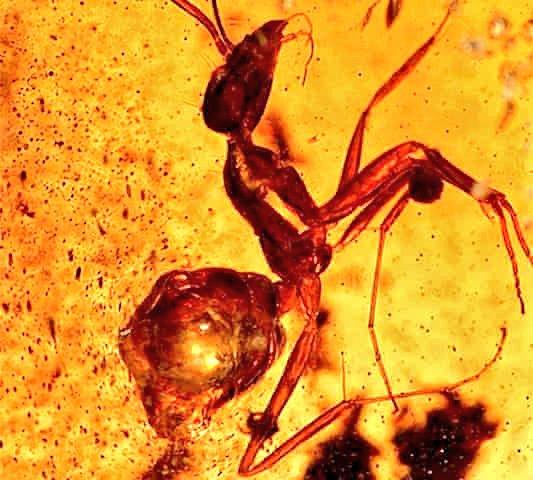
-
@ninawillburger @futurebird damn, you were faster
-
Usually I don't post things older than the late Palaeolithic period, but #insects embedded in amber never cease to amaze me - the sheer age!
This ant preserved in its finest detail is some 50-million-year old.
Found in Gujarat, India.
Photo: University of Bonn@ninawillburger and yes it pretty much looks like a modern ant already, it's quite fascinating
-
How can you tell? (sorry, I'm totally ignorant when it comes to...well any biology
 )
) -
How can you tell? (sorry, I'm totally ignorant when it comes to...well any biology
)@FandaSin @davep @ninawillburger
How can you tell the sex of an ant? Generally if the ant has no wings it's female. All worker ants are female. Male ants are very rare and in most species they will have wings. So if you see an ant without wings (most ants) it's female.
If you see an ant that has wings it's called an "alate" there is a 50/50 chance it's female in that case. Queen alates tend to have larger heads, male alates have very small heads and big eyes.
Bees are also mostly female.
-
@FandaSin @davep @ninawillburger
How can you tell the sex of an ant? Generally if the ant has no wings it's female. All worker ants are female. Male ants are very rare and in most species they will have wings. So if you see an ant without wings (most ants) it's female.
If you see an ant that has wings it's called an "alate" there is a 50/50 chance it's female in that case. Queen alates tend to have larger heads, male alates have very small heads and big eyes.
Bees are also mostly female.
Thank you so much for expanding my knowledge and explaining that to me.

Really appreciated. -
@FandaSin @davep @ninawillburger
How can you tell the sex of an ant? Generally if the ant has no wings it's female. All worker ants are female. Male ants are very rare and in most species they will have wings. So if you see an ant without wings (most ants) it's female.
If you see an ant that has wings it's called an "alate" there is a 50/50 chance it's female in that case. Queen alates tend to have larger heads, male alates have very small heads and big eyes.
Bees are also mostly female.
@futurebird @FandaSin @davep @ninawillburger
male bees (I think the same goes for male ants) are only around for a certain part of the year.
When the mating season is over worker bees will drag their brothers (who do not work... all they do is sleep, eat, try to fertilize a queen bee) out of the hive to starve and freeze. -
@futurebird @FandaSin @davep @ninawillburger
male bees (I think the same goes for male ants) are only around for a certain part of the year.
When the mating season is over worker bees will drag their brothers (who do not work... all they do is sleep, eat, try to fertilize a queen bee) out of the hive to starve and freeze.@fritzoids @futurebird @FandaSin @ninawillburger
<bucks my ideas up sharpish>
-
@FandaSin @davep @ninawillburger
How can you tell the sex of an ant? Generally if the ant has no wings it's female. All worker ants are female. Male ants are very rare and in most species they will have wings. So if you see an ant without wings (most ants) it's female.
If you see an ant that has wings it's called an "alate" there is a 50/50 chance it's female in that case. Queen alates tend to have larger heads, male alates have very small heads and big eyes.
Bees are also mostly female.
@futurebird
@FandaSin @davep @ninawillburger "So if you see an ant without wings (most ants) it's female".The opposite of Gelflings then?
-
@FandaSin @davep @ninawillburger
How can you tell the sex of an ant? Generally if the ant has no wings it's female. All worker ants are female. Male ants are very rare and in most species they will have wings. So if you see an ant without wings (most ants) it's female.
If you see an ant that has wings it's called an "alate" there is a 50/50 chance it's female in that case. Queen alates tend to have larger heads, male alates have very small heads and big eyes.
Bees are also mostly female.
@futurebird @FandaSin @davep @ninawillburger
Every june, near the solstice, the ants who lived under my cottage and kept the termites away would have a flight. The archway to my porch would be arc’s with alates and attendants.
I’d sit with them and watch